
Transporting hazardous materials (hazmat) across international borders is far more complex than domestic shipping. It requires compliance with multiple regulations, such as the U.S. 49 CFR, Canada’s TDG Regulations, and Mexico’s NOM Standards, alongside international frameworks like the UN Model Regulations. Each country adds unique rules for labeling, documentation, and permits, making cross-border shipments intricate and heavily regulated.
Key points to know:
- Documentation: Shipping papers must include proper shipping names, hazard classes, identification numbers, and a 24-hour emergency contact.
- Labeling: International labeling standards must align with the UN framework, but countries like Canada and Mexico may require additional labels or placards.
- Permits: High-risk materials may require permits like Canada’s ERAP or the U.S. HMSP.
- Driver Credentials: Cross-border drivers need specific credentials like a FAST card or TWIC for security clearance.
- Penalties: Non-compliance can result in fines up to $186,610 for severe violations or $500,000 for corporations.
Understanding these rules is critical to avoid shipment delays, fines, or safety risks. The article provides a detailed guide to help shippers navigate these regulations and ensure compliance.
Who Sets The Rules For HAZMAT Transportation?
Global Frameworks for Hazmat Transport
The movement of hazardous materials across borders relies on the United Nations Model Regulations on the Transport of Dangerous Goods, commonly referred to as the "Orange Book." First introduced in 1957, these guidelines establish global standards for classifying, marking, labeling, and packaging dangerous goods. They cover key areas such as training and transport operations, providing a unified foundation for regulatory development that promotes both trade efficiency and safety [1].
By harmonizing regulations, the framework minimizes compliance costs and eliminates conflicting national rules, making multimodal shipments more straightforward [1]. For instance, a chemical shipment that starts on a truck, moves to rail, and ends on a cargo ship can maintain consistent documentation and labeling throughout its journey. This consistency is vital for understanding global updates and the specific rules governing each mode of transport.
UN Model Regulations and Harmonization
The UN Model Regulations are periodically revised – like the Nineteenth Revised Edition – to incorporate the latest safety data and technological advancements [1]. While the UN creates the model, these guidelines only become enforceable when adopted by national governments or international organizations such as the International Maritime Organization (IMO) or the International Civil Aviation Organization (ICAO) [1].
This adoption ensures smoother international trade in hazardous materials. When all jurisdictions align with the framework, shipments can cross borders and switch between transport modes without needing reclassification [1].
Regulations by Transport Mode
Although the UN framework serves as a universal baseline, each mode of transport addresses its unique risks through specific regulations.
- Maritime transport follows the International Maritime Dangerous Goods (IMDG) Code, which accounts for challenges like saltwater corrosion and ship stability.
- Air transport adheres to the ICAO Technical Instructions and the IATA Dangerous Goods Regulations, addressing issues such as cargo space limitations and cabin pressure changes.
- For road, rail, and inland waterways in Europe, regional agreements like ADR (road), RID (rail), and ADN (inland waterways) govern hazardous materials transport [1].
These mode-specific regulations are built on the UN framework, allowing a container classified under UN standards to move seamlessly across different transport modes without needing new labels or documentation, provided the packaging meets the requirements of each mode [1].
How Countries Implement Global Standards
National governments adapt the global framework to meet local safety and logistical needs. For example, the U.S. enforces these standards through 49 CFR, while Canada uses the Transportation of Dangerous Goods Regulations (TDGR). While the core classification system remains consistent worldwide – such as Class 3 flammable liquids being universally recognized – countries often impose additional measures. These may include stricter driver training, vehicle inspections, or emergency response protocols.
Understanding how your shipment’s origin and destination countries implement the UN framework is critical for ensuring compliance and avoiding complications.
This content is for informational purposes only. Always consult official regulations and qualified professionals before making sourcing or formulation decisions.
Requirements by Region and Corridor
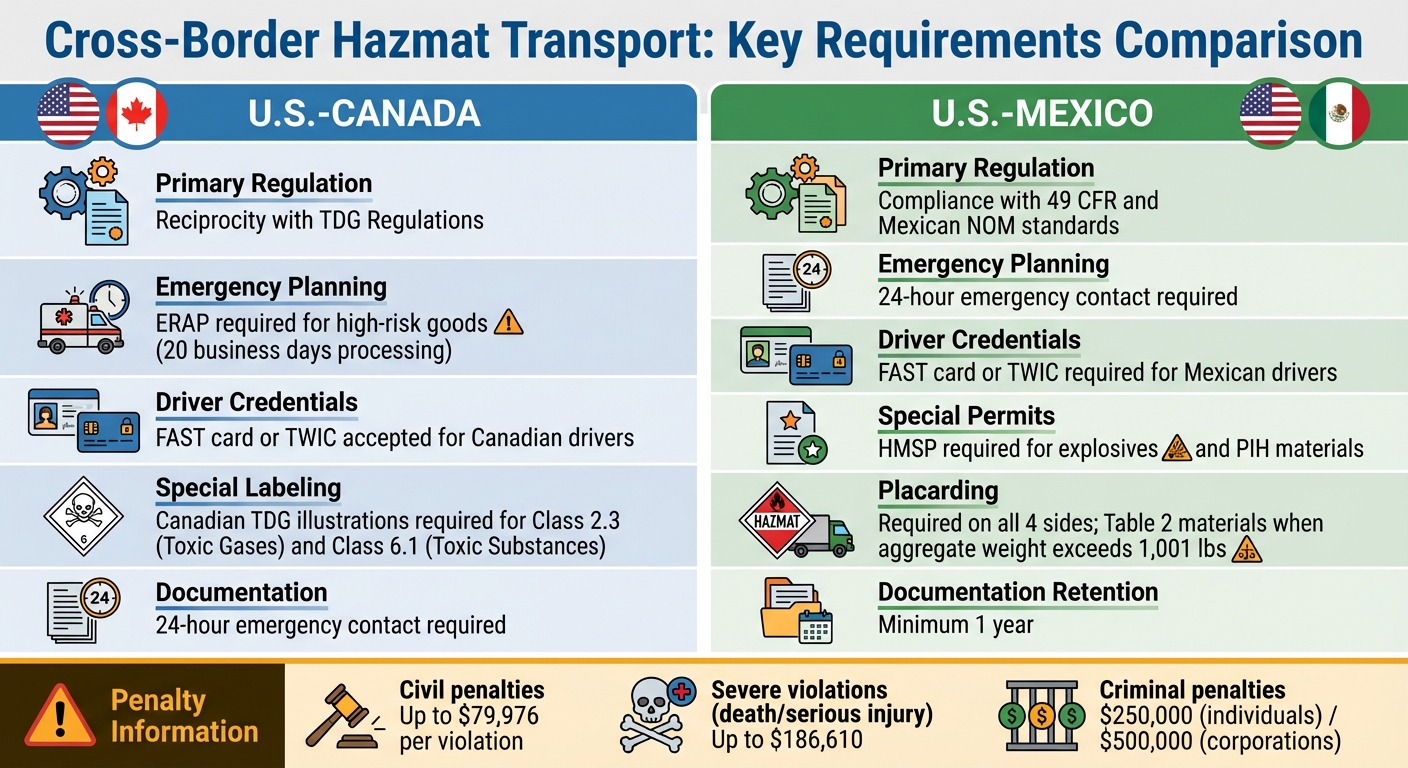
Cross-Border Hazmat Transport Requirements: U.S.-Canada vs U.S.-Mexico Comparison
The UN framework offers a global standard for hazardous materials transport, but each cross-border corridor comes with its own set of rules. These regulations, shaped by local agreements and enforcement practices, are designed to prevent delays and ensure compliance.
U.S.–Canada Hazmat Transport
Transporting hazardous materials between the U.S. and Canada benefits from reciprocity under 49 CFR, but there are unique requirements to navigate. For instance, while most shipments can cross without reclassification, certain conditions must be met.
One key difference is Canada’s requirement for an Emergency Response Assistance Plan (ERAP). For some high-risk goods, an approved ERAP is mandatory before crossing the border. Obtaining an ERAP reference number from Transport Canada can take up to 20 business days, and this number, along with a 24-hour emergency contact, must appear on shipping documents [5].
Canadian drivers entering the U.S. must meet background check requirements similar to the U.S. Hazardous Materials Endorsement (HME). Holding a Free and Secure Trade (FAST) card or a Transportation Worker Identification Credential (TWIC) satisfies this requirement, as outlined in 49 CFR Part 1572:
A commercial motor vehicle driver who holds a current Free and Secure Trade (FAST) program card satisfies the requirements of this section [regarding background checks] [4].
Labeling rules also differ slightly. While most hazard classes are handled with reciprocity, Canada requires specific labels and placards for Class 2.3 (Toxic Gases) and Class 6.1 (Toxic Substances) that align with its Transportation of Dangerous Goods (TDG) Regulations rather than U.S. standards. Additionally, large containment units for reshipped goods in Canada must display placards as per TDG Part 4, even if prepared under 49 CFR [5].
| Feature | U.S. Domestic (49 CFR) | U.S.–Canada Cross-Border |
|---|---|---|
| Primary Regulation | 49 CFR Parts 100–185 | Reciprocity with TDG Regulations [5] |
| Emergency Planning | Emergency response info/phone | ERAP required for high-risk goods in Canada [5] |
| Driver Credential | State-issued CDL with HME | FAST card or TWIC accepted for Canadian drivers [4] |
| Toxic Labels | 49 CFR standard labels | Canadian TDG illustrations required [5] |
U.S.–Mexico Hazmat Transport
Transporting hazardous materials between the U.S. and Mexico involves more documentation and permits compared to U.S.–Canada shipments. Compliance with both 49 CFR and Mexican NOM standards is essential.
Mexican drivers entering the U.S. must undergo background checks similar to U.S. HME requirements, and a FAST card or TWIC can fulfill this obligation. These credentials also help streamline customs clearance and TSA security checks [4].
Motor carriers transporting high-risk materials, such as explosives or Materials Poisonous by Inhalation (PIH), must obtain a Hazardous Materials Safety Permit (HMSP). This permit is mandatory for both domestic and foreign carriers operating in the U.S. [2].
Documentation plays a critical role at the U.S.–Mexico border. Shipping papers must include detailed information such as the proper shipping name, hazard class, identification number, and packing group. A 24-hour emergency contact familiar with the shipment must also be listed. Additionally, carriers are required to retain these documents for at least one year after acceptance [2].
Vehicles must be placarded on all four sides, with placarding required for "Table 2" materials when the aggregate gross weight exceeds 1,001 lbs (454 kg). Packages must also be labeled with their hazard class and marked with the proper shipping name and UN/NA identification number. Noncompliance can result in civil penalties of up to $79,976 per violation, or $186,610 if a violation leads to severe harm or death [2].
Intra-European Union Transport
The European Union takes a harmonized approach to hazardous materials transport, simplifying compliance across member states. Road shipments follow ADR (Accord européen relatif au transport international des marchandises Dangereuses par Route), while rail transport adheres to RID (Règlement concernant le transport International ferroviaire des marchandises Dangereuses) [1]. Both frameworks align with the UN Model Regulations to maintain consistency with global standards.
This harmonization allows shipments classified and packaged in one EU country – like Germany – to move through others, such as France or Belgium, without needing reclassification or relabeling. However, some member states may impose additional rules for specific materials, routes, or tunnel restrictions.
Another advantage within the EU is the mutual recognition of training certificates and safety documentation. A driver certified in one member state can operate throughout the EU, provided their certification is current and covers the relevant hazard classes. This reciprocity often extends to vehicle inspections and safety equipment, though carriers should verify any country-specific requirements before departure.
This content is for informational purposes only. Always consult official regulations and qualified professionals before making sourcing or formulation decisions.
sbb-itb-aa4586a
Compliance Checklist for Cross-Border Transport
Transporting hazardous materials (hazmat) across borders requires meticulous attention to classification, packaging, and documentation. The UN Model Regulations serve as a global framework for ensuring the safe movement of these shipments across multiple countries and transport modes without the need for reclassification or relabeling. Below, we’ve outlined the essential steps to help ensure compliance and avoid costly mistakes.
Material Classification and Labeling
Start by assigning each hazardous material its correct UN number, hazard class, and packing group. These classifications, based on the UN Model Regulations, set the baseline standards recognized by most international, regional, and national authorities. Proper classification is critical because it directly impacts packaging choices and emergency response protocols.
To simplify compliance, use harmonized labeling that aligns with UN standards. This ensures recognition across key regions, including the U.S., Canada, Mexico, and the EU. By standardizing labels, you reduce training challenges and minimize the risk of errors. For instance, bulk packages exceeding 1,000 gallons must display identification numbers on all four sides[2].
Packaging and Containers
When shipping hazmat across borders, always use UN-approved packaging. These containers are specifically designed to meet the safety standards required by both the origin and destination countries, eliminating the need for repackaging at border crossings. The choice of packaging depends on the material’s hazard class, physical state, and compatibility with the container’s materials.
Documentation and Permits
Accurate documentation is just as important as proper packaging. For example, U.S.–Mexico shipments require detailed shipping papers that include the proper shipping name, hazard class, ID number, and packing group[2]. Additionally, a 24-hour emergency contact number must be included, and the responder should be knowledgeable about the shipped materials. If you’re using a service like CHEMTREC, ensure your contract is active before listing their number.
High-risk shipments, such as those involving explosives or inhalation poisons, often require additional permits. The Hazardous Materials Safety Permit (HMSP) is mandatory for these materials, including bulk liquefied natural gas. Motor carriers can apply for this permit through the Federal Motor Carrier Safety Administration (FMCSA) during their scheduled MCS-150 filing process[2]. For materials like radioactive substances or explosives, an annual hazardous materials registration is also required. Contact the PHMSA registration program at 1-800-467-4922 for assistance[2].
Be sure to retain shipping papers for at least one year[2]. Non-compliance can lead to severe penalties, with civil fines reaching up to $79,976 per violation, or $186,610 if the violation results in death, serious illness, or severe injury. Criminal penalties are even steeper, with fines of up to $250,000 for individuals and $500,000 for corporations[2].
This information is intended for general guidance. Always consult official regulations and qualified professionals for specific compliance requirements.
Recent Trends and Best Practices
Regulatory Updates and Digital Tracking
In 2024, PHMSA finalized rules to align the U.S. Hazardous Materials Regulations with UN standards for shipping names, hazard classes, and packing groups [6]. This alignment simplifies cross-border trade by reducing the need for reclassification or repackaging when shipments move internationally.
As of December 31, 2020, shippers replaced the "ORM-D Consumer Commodity" marking with "Limited Quantity" for low-risk hazardous materials [2].
Additionally, digital tracking systems now provide round-the-clock monitoring of emergency response numbers and streamline incident reporting with immediate notifications [2].
These regulatory updates lay the groundwork for improved practices to ensure smoother hazmat compliance.
Recommended Practices for Compliance
To build on these regulatory changes and advancements in digital tracking, consider adopting these practices to strengthen hazmat compliance across borders:
Accurate material classification remains a cornerstone of compliance:
Identification of a hazardous material is the first step, and frequently the most difficult. It is from the proper identification of the hazardous materials that the other requirements are based on [2].
Digital tools, such as those referencing 49 CFR 172.101, can help reduce classification errors and simplify labeling and packaging processes.
Keep hazmat shipping papers on file for at least one year, as part of updated best practices [2]. Ensure emergency contacts are easily accessible, personnel are well-trained, and security plans for high-risk materials are regularly reviewed and updated.
For businesses sourcing chemicals for international transport, working with experienced partners like Allan Chemical Corporation can make a significant difference. With over 40 years of expertise, Allan Chemical Corporation offers technical support to navigate the complexities of international hazmat compliance, ensuring materials are properly classified and documented.
This content is for informational purposes only. Always consult official regulations and qualified professionals before making sourcing or formulation decisions.
Conclusion
Transporting hazardous materials across borders requires meticulous attention to classification, documentation, and compliance with transportation-specific regulations. The UN Model Regulations offer a unified baseline, but individual countries often add their own layers of requirements. Understanding and adhering to these rules is not just a legal obligation – it’s a necessity. Failure to comply can lead to penalties as high as $238,809 per violation, particularly when violations result in severe consequences like fatalities, serious injuries, or major property damage [7].
Brandon Bay from Logistics Group International highlights the broader stakes:
The costs [of non-compliance] are not solely financial but can include irreversible damage to human life, wildlife, and the environment [3].
This perspective underscores the importance of proper classification, packaging, labeling, and documentation, all of which are critical pillars for safe and compliant transport.
While advances like digital tracking and updated regulations have simplified some aspects of cross-border hazmat transport, the complexity of navigating multiple jurisdictions remains. Companies that prioritize regular training, maintain thorough records, and vet carriers carefully can significantly reduce risks like shipment rejections or supply chain disruptions. Aligning with global standards and ensuring rigorous compliance practices are key to achieving both safety and operational efficiency.
For expert guidance, consider partnering with experienced providers like Allan Chemical Corporation. With over 40 years of expertise in regulated industries, they offer technical support to help businesses classify and document materials correctly for international transport. Success in cross-border hazmat logistics hinges on clear classification, accurate documentation, and collaboration with knowledgeable partners.
This content is intended for informational purposes only. Always consult official regulations and qualified professionals for specific decisions regarding sourcing or formulation.
FAQs
What challenges do companies face when transporting hazardous materials internationally?
Transporting hazardous materials across international borders is no small feat. The process is complicated by a maze of regulations that often differ from one country to another. While the United Nations Model Regulations aim to create a uniform framework, many nations add their own rules, which can make compliance tricky. Companies must juggle variations in classification codes, packaging requirements, and documentation standards – each of which can change depending on the region or the mode of transport.
One of the biggest challenges lies in getting the details right for labeling, packaging, and documentation. International shipments demand precise transport paperwork, clear hazard markings like UN numbers and hazard class symbols, and adherence to strict packaging standards tailored to the mode of transport – whether it’s by road, rail, sea, or air. Errors in any of these areas can result in shipment delays, hefty fines, or even serious safety issues.
For companies such as Allan Chemical Corporation, overcoming these obstacles is essential to ensure that hazardous materials are shipped safely, efficiently, and in full compliance with regulatory requirements.
What are the benefits of the UN Model Regulations for transporting hazardous materials internationally?
The UN Model Regulations simplify the international transport of hazardous materials by providing a standardized global framework. This approach minimizes the challenges posed by differing national regulations, ensuring smoother and more consistent operations across borders.
With these regulations in place, there’s no need to reclassify, relabel, or repackage materials when moving between countries or transportation methods. This not only cuts costs but also enhances safety and simplifies compliance and training for cross-border shipments.
What permits and credentials do drivers need to transport hazardous materials across borders?
To move hazardous materials across international borders, drivers must hold a valid Commercial Driver’s License (CDL) with a hazardous materials (H) endorsement. They are also required to complete the TSA Hazardous Materials Endorsement (HME) threat assessment and secure a Federal Hazardous Materials Safety Permit (HMSP) from the FMCSA.
In addition to these, drivers need a USDOT number, registration with PHMSA, and the appropriate reciprocity credential for cross-border transportation, such as the US-Mexico or US-Canada CDL equivalency. These qualifications ensure adherence to safety and regulatory standards when transporting hazardous materials internationally.

Comments are closed