
Waterborne acrylic resins are water-based dispersions of acrylic polymers, primarily used to reduce volatile organic compounds (VOCs) by 80–90% compared to solvent-based systems. These resins improve safety, lower emissions, and meet strict U.S. regulations like EPA standards. Their applications span architectural paints, industrial coatings, adhesives, and textiles, offering benefits such as reduced odor, easier cleanup, and better durability.
Recent advancements include hybrid resin systems (e.g., urethane-acrylic blends), advanced polymerization methods for precise control, and bio-based monomers for reduced environmental impact. These innovations have improved adhesion, UV resistance, and drying performance, making waterborne acrylics a competitive alternative to solvent-based options across industries. Specialty chemical providers play a key role in supplying high-quality raw materials and ensuring regulatory compliance.
Key highlights:
- VOC Reduction: Up to 95% lower emissions.
- Performance Improvements: Better durability, adhesion, and drying.
- Applications: Coatings, adhesives, textiles, and electronics.
- Future Trends: Bio-based components, hybrid technologies, and nanomaterials.
Waterborne acrylic resins are increasingly replacing solvent-based systems, driven by regulatory demands and improved performance.
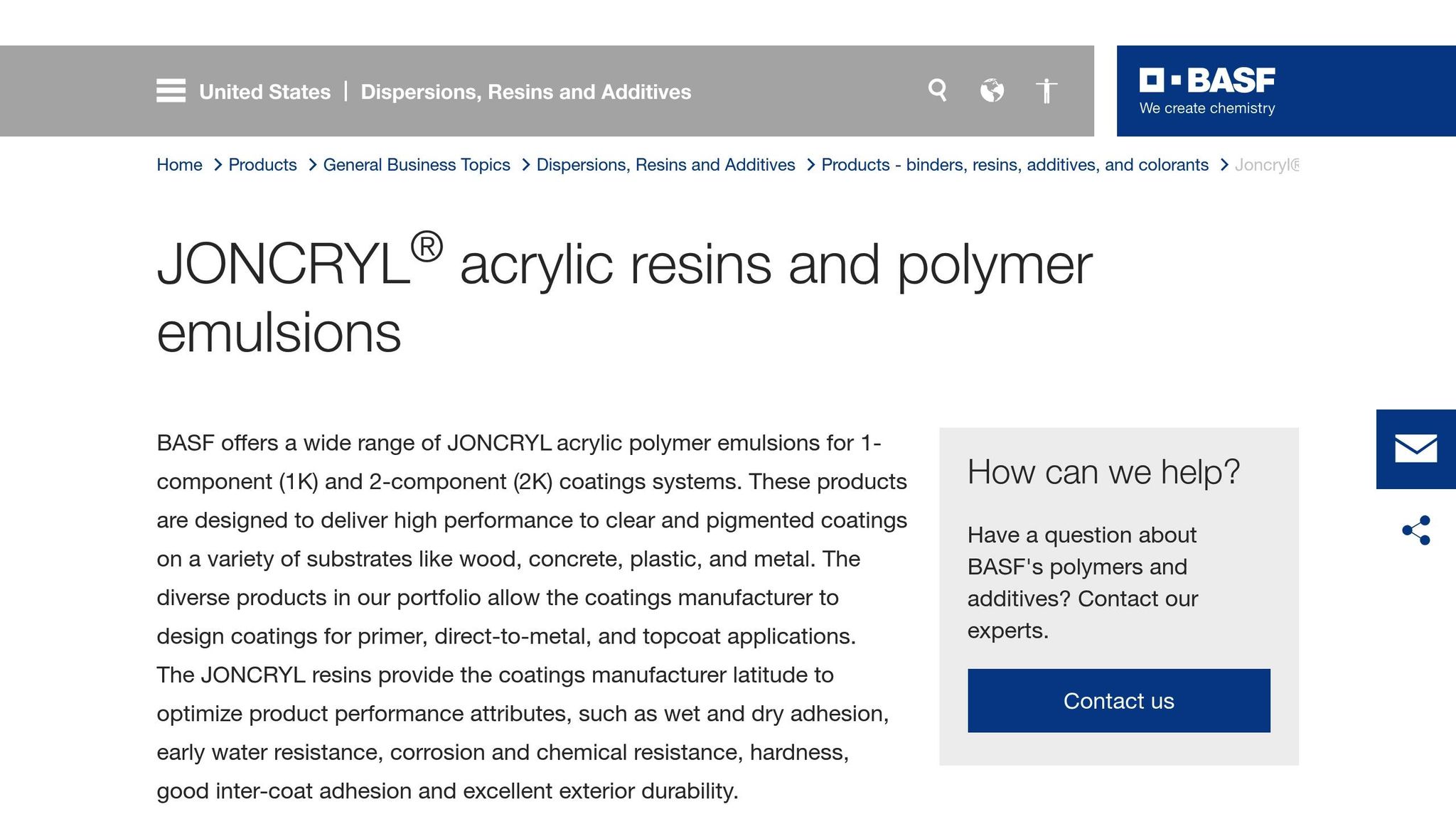
Time to glow! Joncryl® OH 8710 — Innovative GAS Technology for High-gloss Waterborne 2K PU Top Coat
New Synthesis Methods
Recent advancements in waterborne acrylic resin synthesis aim to reduce emissions, improve performance, and promote sustainability. These methods focus on increasing solids content, minimizing harmful emissions, and enhancing film properties, all while maintaining competitive lifecycle costs. For U.S. manufacturers, this means easier compliance with EPA and local air quality regulations, improved durability for architectural and industrial coatings, and greater processing efficiency – without needing significant equipment upgrades.
Advanced Polymerization Techniques
Modern waterborne acrylic production relies heavily on advanced emulsion polymerization techniques, which allow precise control over molecular weight, particle size, and polymer structure. These methods ensure greater consistency between batches and more predictable coating properties, reducing the likelihood of off-spec material. For manufacturers, this translates to shorter development cycles and the ability to create products tailored to specific U.S. markets, such as exterior paints or OEM metal coatings.
Multistage or core–shell processes are particularly noteworthy. By placing harder polymer segments in the core and softer or functional segments in the shell, these techniques enhance block resistance, dirt pickup resistance, and adhesion – all without altering application viscosity. This gives formulators the flexibility to adjust performance characteristics during synthesis, reducing reliance on post-formulation additives.
Mini-emulsion and micro-emulsion processes use smaller, more stable droplets stabilized by optimized surfactant systems. These processes produce finer, more uniform polymer particles, making them ideal for coatings requiring high levels of functional or hydrophobic comonomers. They also improve optical clarity and barrier properties, making them suitable for high-performance coatings, industrial finishes, and specialty inks. These methods are particularly valuable for applications where gloss, transparency, or chemical resistance is essential, and where U.S. customers are willing to pay a premium for superior performance. Additionally, these processes help manufacturers meet regulatory standards while enhancing product quality.
Hybrid resin technologies are another major development. These systems combine acrylics with polymers like urethanes, silicones, or fluoropolymers to create stable waterborne solutions. For example, one-component waterborne PVDF–acrylic hybrid dispersions, first introduced in the early 2000s, now provide weatherability comparable to high-end solvent-based fluoropolymers but in a waterborne format. These hybrids offer enhanced abrasion resistance, chemical durability, flexibility, and weatherability, making them ideal for demanding applications such as coil coatings and building materials.
The key challenge with hybrids lies in achieving long-term colloidal stability and coalescence without relying on added solvents. Modern approaches use tailored surfactants, reactive emulsifiers, and self-crosslinking monomers to maintain both stability and performance. Compared to earlier waterborne acrylics, today’s hybrid dispersions exhibit much better resistance to chalking, gloss loss, and chemical degradation, enabling them to compete with solvent-based systems in applications like industrial and architectural coatings.
U.S. manufacturers can often adopt these advanced methods using their existing facilities. By starting with pilot batches, adjusting monomer feeds, and updating process controls, companies can implement these techniques without major capital investments. Upgraded dosing systems and online monitoring tools further enable the production of advanced recipes on current equipment. Collaborating with raw material suppliers and toll manufacturers can also help bridge any capability gaps, allowing manufacturers to test new systems while minimizing risk and upfront costs.
These innovations not only enhance product performance but also open doors to more environmentally friendly synthesis methods.
Eco-Friendly Synthesis Approaches
Building on polymerization advancements, newer synthesis methods aim to further minimize environmental impact. Sustainability is driving innovations such as replacing fossil-derived acrylates with bio-based monomers, recycling process water, and using low-temperature polymerization to reduce energy consumption. Renewable raw materials include bio-based acrylate or methacrylate monomers derived from plant oils, sugars, or lignin, as well as bio-based plasticizers and coalescents.
While these approaches reduce the carbon footprint of resins and align with corporate sustainability goals, they come with trade-offs. Challenges include the cost and availability of bio-based feedstocks, potential changes in properties like hardness or water resistance, and supply variability. Formulators must carefully balance these factors, often requiring extensive pilot testing and robust supplier partnerships to ensure consistent quality and performance for U.S. customers.
A practical strategy involves introducing incremental bio-content, typically 10–30%, while fine-tuning crosslinkers and co-monomers to maintain performance without significantly increasing costs. This approach allows manufacturers to meet sustainability goals while delivering the reliability and durability expected in U.S. architectural and industrial markets.
Modern synthesis methods also emphasize high-solids, low-coalescent formulations, reactive surfactants, and self-crosslinking chemistries to reduce the need for organic solvents. These innovations lower VOC content, helping products comply with stringent U.S. regulations, particularly in states like California with strict VOC limits. For manufacturers, this reduces worker exposure, simplifies permitting, and can lower insurance and ventilation costs at production sites.
Specialty chemical providers play a critical role in supporting these eco-friendly initiatives. They offer tailored materials for regulated industries like automotive, construction, and electronics, along with formulation guidance and testing services. Companies like Allan Chemical Corporation provide high-purity monomers, surfactants, and additives, ensuring compatibility and quality control. Their expertise in regulated industries and just-in-time delivery systems helps manufacturers maintain consistent production while scaling up new synthesis methods.
This content is for informational purposes only. Consult official regulations and qualified professionals before making sourcing or formulation decisions.
Performance Improvements
Thanks to advancements in synthesis techniques, modern waterborne acrylic resins now rival their solvent-based counterparts. These improvements address challenges like water absorption, UV damage, and chemical wear, resulting in coatings with longer lifespans and less need for maintenance. Let’s break down the key areas where these resins have made significant strides: durability, adhesion, and drying performance.
Better Durability and Resistance
Older waterborne acrylics often struggled with issues like water absorption, UV-induced chalking, and weak chemical resistance. However, modern formulations have tackled these problems head-on with innovations such as controlled polymerization, crosslinkable functional groups, and hybrid designs that blend acrylics with fluoropolymers or urethanes. These approaches create tightly bonded, chemically resistant structures that minimize water permeability and stand up to harsh conditions like acid rain, detergents, and industrial pollutants.
Real-world results back up these advancements. Accelerated testing shows improved gloss, color retention, and mechanical strength. Field data from architectural façades and metal roofing reveal that advanced waterborne acrylic and acrylic–PVDF hybrid topcoats can maintain their appearance for over a decade in high-UV regions while resisting dirt accumulation and mildew growth. In industrial and transportation settings, waterborne acrylic and acrylic–urethane systems are increasingly used for OEM and refinishing applications. These coatings offer corrosion protection and chip resistance, reducing downtime and lowering ownership costs. Such durability naturally complements improved adhesion and flexibility.
Stronger Adhesion and Flexibility
Adhesion, particularly on challenging surfaces like metals, plastics, and concrete, has historically been a weak point for waterborne acrylics. Modern formulations address this by incorporating tailored polar groups and optimizing particle distributions, ensuring strong bonds even in demanding conditions. U.S. formulators often enhance these systems with adhesion promoters, surface-active additives, and primers customized for specific substrates, further boosting performance.
Flexibility has also seen a leap forward. By fine-tuning the glass transition temperature, molecular weight distribution, and blending with flexible segments like polyurethane, these coatings now resist cracking and delamination even when substrates move, experience impacts, or undergo temperature changes. Validated through rigorous industry tests, these improvements expand the range of applications for waterborne acrylics, especially in markets requiring both flexibility and durability.
Faster Drying and Film Formation
Speed matters in today’s production environments, and modern waterborne acrylics deliver with faster drying and improved film formation. These formulations feature lower film-forming temperatures and optimized particle sizes to speed up water evaporation. Compliant coalescents ensure smooth, uniform films. For U.S. OEM and on-site applications, adjustments to solids content, viscosity, and airflow/temperature profiles allow coatings to dry quickly, enabling rapid recoating and producing durable, defect-free finishes.
The challenge lies in balancing quick drying with enough open time for application methods like brushing, rolling, or spraying. By carefully managing evaporation rates, rheology modifiers, and coalescent systems, formulators achieve this balance. The result? Increased daily coverage, shorter project timelines, and the ability to apply multiple coats in a single shift. These benefits enhance productivity while maintaining high-quality standards, making them especially valuable in U.S. industrial and architectural markets.
When assessing new waterborne acrylic resins, U.S.-based formulators and end users should focus on critical performance metrics. Tests like crosshatch or pull-off adhesion measurements, gloss and color retention after weathering, and resistance to water, chemicals, impact, and abrasion (using ASTM or ISO methods) are key indicators. Practical measures such as tack-free time, recoat windows, hardness development, and blocking resistance also provide useful insights. Specialty chemical providers play a vital role in this process by offering tailored acrylic monomers, additives, and complementary chemistries that support low-VOC, high-performance formulations. Companies like Allan Chemical Corporation, with expertise spanning industries such as pharmaceuticals, cosmetics, and electronics, can guide manufacturers in sourcing the precise inputs needed to meet the demands of advanced waterborne acrylic technologies.
This content is for informational purposes only. Always consult official regulations and qualified professionals before making sourcing or formulation decisions.
sbb-itb-aa4586a
Regulatory and Environmental Considerations
The move toward waterborne acrylic resins is not just about better performance; it’s also about keeping up with stricter regulations and growing environmental expectations. As governments enforce tougher emissions standards and companies prioritize eco-friendly practices, advanced waterborne formulations are becoming a practical solution for meeting both compliance requirements and environmental goals.
Meeting Global Standards
Modern waterborne acrylic resin technologies are crafted to align with key regulations, including the U.S. Environmental Protection Agency (EPA) rules on volatile organic compounds (VOCs) and hazardous air pollutants (HAPs). They also comply with European Union frameworks like REACH and industrial emissions directives. These regulations set specific VOC limits for coatings, promote the replacement of hazardous materials, and require documented performance during application and curing. In the U.S., manufacturers must navigate federal standards alongside stricter state-level rules, especially in states like California.
These formulations achieve VOC reductions of 80–95% by using water instead of traditional organic solvents [1]. This allows manufacturers to meet regulatory thresholds while maintaining the performance needed for industrial and architectural coatings.
For U.S.-based manufacturers, suppliers who provide thorough documentation – such as safety data sheets, VOC certifications, and proof of compliance with EPA and international standards – are highly valued. Specialty chemical providers with strong quality and environmental management systems help reduce regulatory risks and make audits easier. Formulators are also expected to document VOC content in grams per liter using approved U.S. testing methods and track lifecycle metrics like carbon footprint and recyclability. This data-driven approach helps make a strong case for adopting advanced waterborne acrylic technologies.
By focusing on compliance, manufacturers not only meet legal requirements but also contribute to meaningful environmental advancements.
Environmental Benefits
Compared to solventborne systems, waterborne acrylic resins offer clear environmental advantages. During application and drying, they release far fewer VOCs and hazardous solvents, which helps reduce ground-level ozone formation and limits worker exposure. Additionally, their enhanced durability means coatings last longer, reducing the need for frequent maintenance and recoating. This extended lifespan further minimizes cumulative emissions and material usage.
Worker safety also benefits from these formulations, as they avoid or significantly reduce the use of substances classified as carcinogenic, mutagenic, or toxic to reproduction. Heavy-metal driers and certain plasticizers, which are often under regulatory scrutiny, are also minimized or eliminated. Reduced solvent exposure during mixing, spraying, and curing creates safer working conditions and helps companies comply with occupational health standards.
There is also a growing push to incorporate renewable resources into waterborne acrylic resin production. Some manufacturers are integrating bio-based components, such as plant-derived monomers and reactive diluents, into their formulations. These changes lower the carbon footprint of the resins, as lifecycle assessments often show reduced greenhouse gas emissions and better resource efficiency. While current commercial formulations typically include 10% to 30% bio-based content, ongoing research aims to increase this percentage without compromising performance.
To maximize these benefits, formulators should focus on developing high-solids, low-VOC waterborne acrylic systems. They must also validate performance under conditions relevant to the U.S. climate and update equipment and training to optimize application and curing processes. End users can enhance environmental outcomes by adopting best practices, such as controlled application environments, proper waste management, and detailed documentation of VOC reductions and extended maintenance intervals.
Specialty chemical providers play a key role in supporting these efforts by offering technical-grade ingredients that meet stringent purity and documentation standards for coatings and adhesives. With reliable supplier networks, just-in-time delivery, and robust quality systems, these providers help manufacturers secure the raw materials needed for advanced waterborne acrylic technologies while ensuring compliance with current regulations. Allan Chemical Corporation, with over 40 years of experience in regulated industries, is well-positioned to assist manufacturers in sourcing the precise inputs required for these advanced formulations.
This content is for informational purposes only. Always consult official regulations and qualified professionals before making sourcing or formulation decisions.
Role of Specialty Chemical Providers
As advancements in synthesis and performance continue to shape waterborne acrylic resins, specialty chemical providers play a key role in connecting these innovations to practical applications. Acting as a bridge between raw material suppliers and manufacturers, these providers ensure that high-quality materials are delivered on time, meet regulatory requirements, and align with the technical needs of increasingly sophisticated formulations. This essential network supports both the adoption of new technologies and the consistency of product quality.
Market trends highlight the growing demand for reliable raw materials. For example, the global market for waterborne acrylic resins is expected to grow from $12.8 billion in 2025 to $18.9 billion by 2035, with the U.S. market projected to reach $4.4 billion in 2025 [1][3]. This surge in demand places significant pressure on supply chains to deliver materials that meet both performance and environmental benchmarks.
Sourcing High-Quality Materials
The foundation of consistent performance lies in reliable sourcing. Manufacturers of waterborne acrylic formulations require raw materials that meet precise standards every time. Variations in purity, molecular weight distribution, or residual impurities can impact critical factors like adhesion, durability, and film formation. These concerns are even more pronounced in industries with strict regulations, such as pharmaceuticals, food packaging, and electronics.
Specialty chemical providers address these challenges by partnering with verified manufacturers and conducting rigorous quality checks. They supply materials that meet established standards, including USP, ACS, and FCC grades, and provide comprehensive documentation packages such as certificates of analysis, specifications, and safety data sheets. This robust documentation is crucial for regulatory compliance and lifecycle assessments.
Timely availability is just as important as quality. Delays or shortages of critical materials can disrupt production schedules. To mitigate this, just-in-time delivery models help manufacturers maintain efficient operations without overstocking. This approach is especially beneficial for businesses managing multiple formulations or responding to fluctuating demand for eco-friendly coatings. Additionally, flexible batch sizes and custom packaging options support streamlined production processes and reduce waste.
Supporting Progress Through Collaboration
Advancements in waterborne acrylic resin technology often stem from collaboration. Partnerships between raw material suppliers, resin manufacturers, formulators, and research institutions drive the development of new synthesis methods, performance enhancements, and application-specific solutions.
For instance, in March 2025, DuPont and BASF announced a partnership to develop high-performance acrylic binders for waterborne coatings, aiming to improve film formation and weather resistance across various segments [2]. Such collaborations accelerate progress, demonstrating how shared technical knowledge and joint testing efforts can lead to optimized formulations tailored to specific needs.
Beyond supplying materials, specialty chemical providers offer technical support to help manufacturers overcome formulation challenges, explore alternative raw materials, and adapt to emerging trends. This expertise is especially valuable when developing new products or adjusting formulations to meet stricter environmental standards.
The integration of advanced polymer technologies, such as nanomaterials and hybrid resin systems, requires close coordination between suppliers and manufacturers. For example, hybrid PVDF-acrylic technologies combine the durability of polyvinylidene fluoride with the flexibility of acrylic resins, enabling applications in demanding environments [6]. Developing these formulations relies on suppliers who can source diverse components, ensure consistent quality, and assist with scaling production.
Collaboration also plays a role in sustainability efforts. Sherwin-Williams‘ Water-borne Acrylic Alkyd Technology, for example, incorporates recycled PET and soybean oil, reducing VOC emissions by about 60% and eliminating over 800,000 pounds of VOCs in 2010 [7]. Achieving such results required partnerships among resin suppliers, raw material providers, and formulators to validate performance while maintaining eco-friendly credentials. Specialty providers contribute to these initiatives by sourcing bio-based components and supporting manufacturers in aligning with sustainability goals.
Allan Chemical Corporation‘s Expertise
Specialty suppliers like Allan Chemical Corporation bring valuable expertise to the table, ensuring that advanced formulations meet both technical and regulatory demands. Their sourcing-first approach allows them to deliver materials tailored to specific customer needs. By maintaining strong relationships with manufacturers worldwide, Allan Chemical Corporation ensures access to high-quality inputs for waterborne acrylic formulations.
The company serves industries such as plastics, adhesives, and lubricants, all of which rely on acrylic resins. Their experience with regulated sectors like pharmaceuticals, food, cosmetics, ceramics, and electronics translates seamlessly to the coatings industry, where similar quality and documentation standards apply. Many of their products meet or exceed established compendial standards, including ACS, USP, NF, and FCC.
Allan Chemical Corporation’s just-in-time delivery service is particularly valuable in today’s market, where demand for eco-friendly coatings is growing rapidly. This model helps manufacturers maintain production schedules without the burden of excessive inventory. Competitive pricing, supported by strong supplier partnerships, allows manufacturers to control costs while maintaining high standards.
The company also specializes in sourcing hard-to-find materials, which is critical for manufacturers developing niche formulations or requiring specific grades of raw materials. Their dedicated Regulatory Document Coordinator manages compliance-related documentation, providing customers with the certificates, specifications, and safety data sheets needed for regulatory and quality assurance. This level of support reduces administrative workloads, enabling manufacturers to focus on innovation and production.
For companies adopting advanced waterborne acrylic technologies, partnering with a specialty chemical provider that understands technical and regulatory complexities can make a significant difference. Allan Chemical Corporation’s extensive experience in regulated industries positions them as a valuable ally for manufacturers working to meet stringent VOC limits, performance criteria, and environmental standards.
This content is for informational purposes only. Always consult official regulations and qualified professionals before making sourcing or formulation decisions.
Conclusion and Future Outlook
Building on earlier discussions around performance, environmental improvements, and regulatory shifts, here’s an overview of the key points and emerging trends shaping the future of waterborne acrylic resin technology.
Key Takeaways
Recent advancements in waterborne acrylic resins have redefined their potential. Modern formulations deliver VOC reductions of 85–95% compared to traditional solventborne coatings[1]. This makes them a critical tool for companies aiming to meet stricter environmental regulations while aligning with internal sustainability goals. These reductions address one of the most pressing challenges for the U.S. coatings industry as federal and state regulations tighten.
On the performance front, waterborne acrylic systems have made significant strides. They now match or surpass solventborne alternatives in durability, weather resistance, and chemical resilience[1][8][5]. Improvements in film formation, adhesion, and drying times mean manufacturers no longer need to compromise quality for lower emissions. For architectural uses, these resins offer extended service life, better gloss retention, and enhanced stain resistance, cutting down on repainting and maintenance costs for buildings across diverse U.S. climates.
In automotive and industrial applications, advanced waterborne acrylics provide excellent chip resistance and corrosion protection for metal surfaces. They also integrate seamlessly with high-speed application lines, enabling manufacturers to modernize operations while meeting stringent OEM specifications. Case studies from states like Texas, California, Ohio, and Illinois show facilities improving environmental performance by about one-third after adopting these systems[1].
Hybrid technologies are expanding possibilities further. PVDF–acrylic dispersions offer fluoropolymer-like weathering and color retention at VOC levels typical of waterborne systems, making them ideal for long-lasting exterior metal applications[4]. Similarly, urethane–acrylic hybrids combine durability and flexibility, bridging the gap between purely acrylic systems and more rigid technologies[5].
The environmental advantages go beyond VOC reductions. Waterborne acrylics lower worker exposure to harmful solvents, reduce flammability risks, simplify cleanup with water, and support companies in promoting greener product narratives. These benefits resonate throughout the value chain, from raw material sourcing to end-of-life considerations.
With these advances, waterborne acrylic resins are poised to drive exciting developments in the years ahead.
Future Trends to Watch
The market for waterborne acrylic technology is on a strong growth trajectory. Projections suggest it will expand from $12.8 billion in 2025 to $18.9 billion by 2035, with a compound annual growth rate (CAGR) of about 4.0%[1]. Another forecast anticipates growth from $5.99 billion in 2025, with a 5.0% CAGR through 2032 as adoption accelerates in coatings, adhesives, and inks[8]. This sustained growth reflects both regulatory pressures and the undeniable performance benefits of waterborne systems.
Several key trends are set to shape the future:
- Nanotechnology: Integrating nanomaterials is enhancing scratch resistance, UV stability, and barrier properties, pushing the boundaries of what waterborne systems can achieve[8].
- Hybrid Resins: Beyond PVDF–acrylic and urethane–acrylic blends, new combinations like acrylic–silane and acrylic–fluoropolymer hybrids are emerging. These address gaps in extreme conditions, such as high humidity, elevated temperatures, or harsh chemical exposure.
- Bio-Based Monomers: The push for bio-based and partially bio-based raw materials is intensifying as manufacturers aim to reduce reliance on fossil feedstocks. Future resins will focus on VOC content, carbon footprint, recyclability, and compatibility with circular economy principles. Life cycle assessments will become routine, emphasizing renewable inputs and coatings that last longer with thinner films.
- Industry-Specific Customization: Tailored formulations are gaining ground in areas like marine coatings, flexible packaging, inkjet printing, and electric-vehicle components. These specialized solutions require close collaboration between resin producers, formulators, and end users to meet unique performance needs.
- Digitalization: Waterborne acrylics are also evolving for high-speed digital printing, functional packaging, and smart coatings that respond to environmental triggers like temperature or moisture. These applications demand precise control over rheology and curing behavior, areas where advanced formulation expertise plays a key role.
Globally, regulatory trends in developing countries are driving VOC reduction mandates of 10–15% annually, further accelerating the adoption of waterborne acrylic systems[1]. Coupled with consumer demand for greener products, these shifts ensure waterborne technology will continue to gain traction across architectural, automotive, industrial, and packaging sectors.
To stay ahead, manufacturers should benchmark new waterborne formulations using standardized tests for weathering, corrosion, and chemical resistance. Collaborating with resin suppliers early in the process can help identify low-VOC, hybrid, and bio-based options that align with specific production needs. Adjusting settings like drying profiles and film thickness can also optimize performance. Partners like Allan Chemical Corporation (https://allanchems.com) offer technical-grade raw materials, regulatory support, and inventory strategies to help U.S. manufacturers implement these innovations efficiently.
The path forward is clear: waterborne acrylic resins are steadily replacing solventborne systems across a growing range of applications. By embracing these advancements and working with knowledgeable suppliers, manufacturers can position themselves to thrive in this evolving landscape.
This content is for informational purposes only. Always consult official regulations and qualified professionals before making sourcing or formulation decisions.
FAQs
What are the key benefits of waterborne acrylic resins compared to solvent-based systems in industrial applications?
Waterborne acrylic resins stand out for their advantages over solvent-based alternatives, making them a preferred option in various industrial sectors. A key benefit is their reduced impact on air quality, as they release fewer volatile organic compounds (VOCs). This not only helps businesses comply with stringent environmental regulations but also creates a safer work environment for employees.
Beyond their environmental appeal, these resins offer strong functional benefits. They deliver reliable adhesion, long-lasting durability, and resistance to harsh weather conditions. Plus, they can be cleaned up with water, eliminating the need for strong chemical solvents. These features make waterborne acrylic resins a practical and eco-conscious choice for many industrial applications.
What are the latest advancements in hybrid resin technologies, and how do they improve the performance and sustainability of waterborne acrylic resins?
Recent developments in hybrid resin technologies have brought new methods of creating waterborne acrylic resins that improve their performance while offering environmental advantages. These advancements have led to enhanced adhesion, greater durability, and improved resistance to challenges like UV exposure and moisture, making these resins suitable for a broader range of uses.
Another key focus of these technologies is the reduction of volatile organic compounds (VOCs), which helps meet stricter environmental regulations and supports eco-conscious practices. By combining improved functionality with a reduced environmental footprint, waterborne acrylic resins are emerging as a preferred choice for industries aiming to balance quality with environmental responsibility.
How do specialty chemical providers help ensure waterborne acrylic resins meet strict U.S. quality and regulatory standards?
Specialty chemical suppliers like Allan Chemical Corporation are essential in ensuring waterborne acrylic resins meet strict quality and regulatory standards. By providing technical-grade and compendial-grade chemicals (such as USP, FCC, ACS, and NF), they help manufacturers comply with demanding U.S. regulations.
With more than 40 years of experience, Allan Chemical Corporation supports industries by delivering reliable solutions. Their expertise ensures that these resins are not only effective but also meet rigorous safety and environmental guidelines, making them suitable for regulated applications across various sectors.



Comments are closed