
Transporting hazardous materials safely requires compliance with U.S. federal regulations under 49 CFR Part 173. These rules ensure proper classification, packaging, and handling of substances that pose risks during transit. Part 173 covers nine hazard classes, including explosives, flammable liquids, and toxic substances, and applies to all transportation modes: air, highway, rail, and water. Noncompliance can lead to illegal shipments, accidents, and environmental harm.
Key highlights of 49 CFR Part 173 include:
- Packaging Standards: Containers must pass performance tests like drop and leakproofness evaluations. Compatibility between packaging materials and contents is mandatory to prevent chemical reactions or leaks.
- Shipper Responsibility: Shippers must ensure proper packaging, labeling, and documentation. This includes following manufacturer-provided closure instructions and conducting thorough inspections.
- Reuse Restrictions: Packaging must meet retesting and marking requirements before reuse. For example, plastic containers must not exceed a five-year use period without retesting.
- Marking and Labeling: Packages must display clear hazard labels, orientation arrows, and proper shipping names. Limited Quantity shipments have distinct exemptions but still require specific markings.
- Testing and Certification: Packaging undergoes rigorous tests for durability and safety. Certification ensures compliance with DOT and UN standards.
Adhering to these regulations is essential for reducing risks and ensuring the safe transport of hazardous materials. Always consult official guidelines and professionals for compliance.
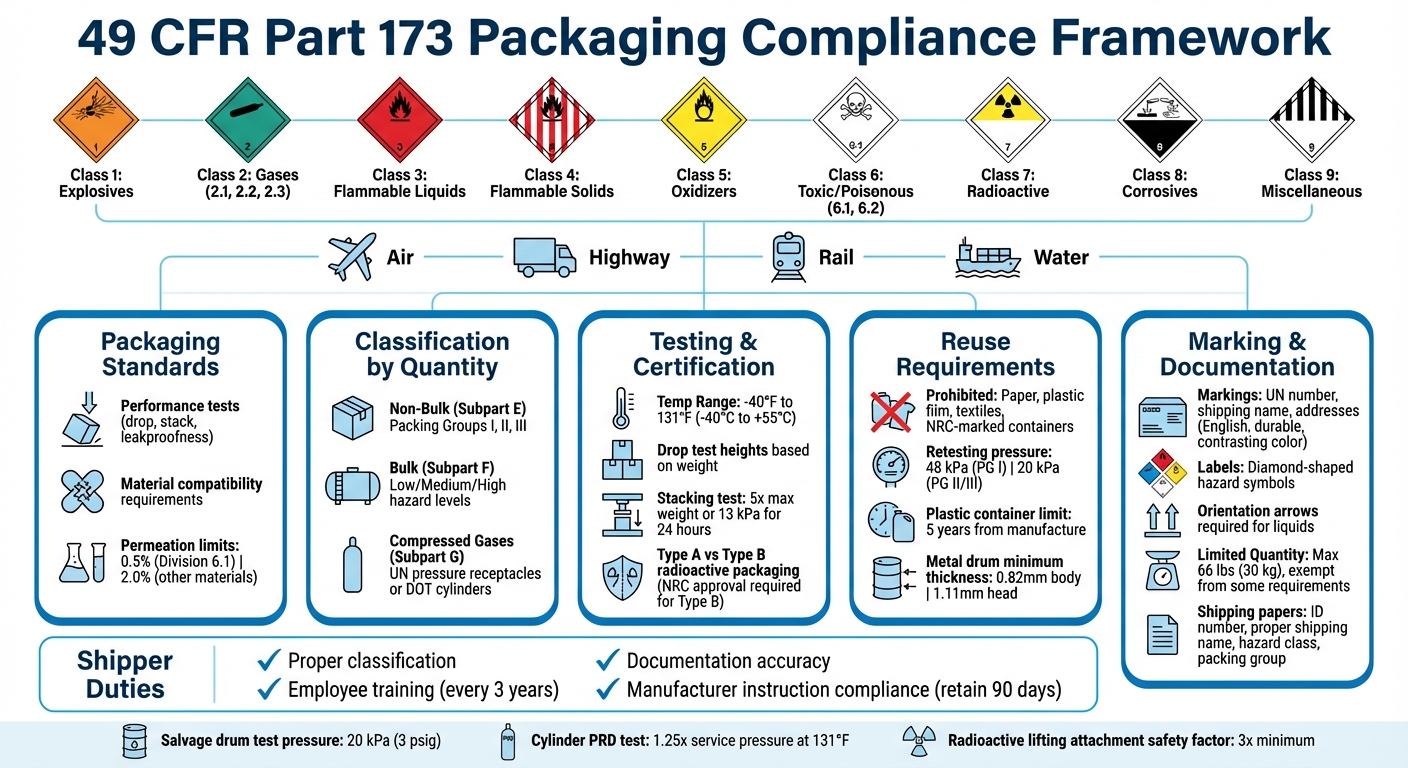
49 CFR Part 173 Hazardous Materials Packaging Compliance Framework
Packaging Requirements for Hazardous Materials – Segment 2
sbb-itb-aa4586a
General Packaging Requirements
When it comes to hazardous materials, packaging must meet universal standards that apply to all hazard classes. These rules ensure the container is compatible with its contents, durable enough to handle transportation stresses, and properly inspected before reuse. The responsibility for meeting these standards lies with the shipper – the individual or entity offering the material for transport. These general principles set the stage for the more detailed requirements outlined below.
Material Compatibility and Integrity
Packaging and contents must work together safely. According to 49 CFR 173.24(e), shippers must ensure that the packaging won’t corrode, soften, or become brittle when in contact with the hazardous material. It must also prevent dangerous permeation. This evaluation should account for the full range of temperatures the package may encounter during transit.
Plastic packaging faces strict permeation limits. For Division 6.1 poisonous materials, the permeation rate must not exceed 0.5%, while for other hazardous materials, the limit is 2.0% [4]. Plastic containers in Packing Group I must undergo rigorous testing as outlined in Appendix B: 180 days at 64°F (18°C), 28 days at 122°F (50°C), or 14 days at 140°F (60°C) [4].
Packaging materials must avoid chemical reactions with their contents. For instance, substances that could lead to combustion, flammable gases, poisonous vapors, or unstable compounds cannot share the same outer container [4]. Even non-regulated items should be isolated if a hazardous reaction is possible. For example, highly reactive chemicals should always be packaged separately, regardless of the regulatory status of other items in the shipment [7].
The packaging must endure temperature changes, humidity, pressure variations, shocks, and vibrations without releasing its contents [4][8]. If a solid material might liquefy during transport, the packaging must securely contain it in its liquid state [4].
Closure Standards and Inspection Requirements
Leakproof and secure closures are mandatory. Per 49 CFR 173.24(f), all caps, lids, valves, and sealing mechanisms must prevent leaks [4]. For air transport, friction closures like stoppers or corks must be secured with wire, tape, or locking mechanisms to prevent displacement caused by pressure changes [4].
Shippers must follow the closure instructions provided by the packaging manufacturer. As required by 49 CFR 173.22, a copy of these instructions must be kept for at least 90 days after the package is offered for transport [8][9].
Proper filling levels are crucial to prevent pressure buildup. When packaging liquids, sufficient headspace (ullage) must be left to allow for thermal expansion. Without this space, containers risk leaking or deforming. Before transport, all packages must be inspected to ensure there is no hazardous material residue on the exterior. Damaged, defective, or leaking packages must be placed in a compatible salvage drum marked "SALVAGE" and cushioned appropriately. Salvage drums must pass leakproofness tests at 20 kPa (3 psig), while larger salvage packagings require testing at 30 kPa (4.4 psig) [2].
Packaging Reuse Restrictions
Building on the principles of compatibility and secure closures, reused packaging must meet additional retesting and marking requirements. Reusable packaging must adhere to strict guidelines. According to 49 CFR 173.28, packaging made from paper (excluding fiberboard), plastic film, or textiles cannot be reused [10][11]. Containers marked "NRC" (Non-Reusable Container) may only be reused for materials that do not require DOT or UN standard packaging [10].
Before reuse, packaging must be thoroughly inspected to ensure it is free from incompatible residues, ruptures, or damage that could compromise its integrity [10]. Non-bulk containers originally subject to leakproofness tests must undergo retesting before reuse. The required internal air pressure for retesting is at least 48 kPa (7.0 psig) for Packing Group I and 20 kPa (3.0 psig) for Packing Groups II and III [10][11]. Successfully retested packaging must be marked with the letter "L", the tester’s name or symbol, and the last two digits of the test year [10].
Thickness requirements also determine eligibility for reuse. Metal and plastic drums or jerricans can only be reused if they are permanently marked with their nominal or minimum thickness [10][11]. For example, a 220-liter metal drum manufactured on or after January 1, 1997, must have a body thickness of at least 0.82 mm (0.032 inch) and a head thickness of 1.11 mm (0.044 inch) to qualify for reuse [11]. Similarly, the inner receptacles of composite plastic packagings must maintain a minimum thickness of 1.0 mm (0.039 inch) [10].
Plastic packaging has specific reuse allowances: it can be refilled without leakproofness retesting if the original filler uses a compatible material and the packaging is less than five years old from its manufacture date [10][11]. Additionally, any packaging used for Division 6.2 infectious substances must be disinfected thoroughly to neutralize any residual pathogens before it is reused [10].
This information is provided for guidance only. Always consult official regulations and qualified professionals when making decisions about sourcing or packaging.
Packaging Standards by Hazard Class
Packaging rules for hazardous materials are divided into categories based on whether you’re dealing with non-bulk or bulk quantities. Each hazard class has its own set of requirements. Non-bulk packaging rules are outlined in Subpart E, bulk packaging standards in Subpart F, and compressed gases in Subpart G. These distinctions are essential for choosing the appropriate container for each material, ensuring packaging aligns with the associated risk level.
Non-Bulk Packaging Requirements
Non-bulk packaging requirements are organized by Packing Group (PG), which reflects the material’s hazard level. Liquids are addressed as follows: § 173.201 covers PG I (highest hazard), § 173.202 addresses PG II, and § 173.203 pertains to PG III (lowest hazard). Similarly, solid materials follow these sections: § 173.211 (PG I), § 173.212 (PG II), and § 173.213 (PG III).
Certain reactive substances, like chlorosilanes, require specialized packaging under § 173.206. When a material falls under multiple hazard classes, a specific hierarchy determines precedence. For example, Class 7 (radioactive materials) takes priority, followed by Division 2.3 (poisonous gases) and Division 2.1 (flammable gases). For Class 3 flammable liquids, PG I is assigned when the material’s initial boiling point is 95°F (35°C) or lower.
Bulk Packaging Requirements
Unlike non-bulk packaging, bulk packaging standards are based on overall hazard level rather than Packing Groups. Materials are classified by their hazard level under bulk packaging standards. For example, § 173.240 applies to certain low-hazard solids, while § 173.241 covers low-hazard liquids and solids. Medium-hazard materials, including those with dual hazards, fall under § 173.242. High-hazard liquids and moderate dual-hazard materials must meet the stricter standards in § 173.243.
Some materials require extra precautions. Pyrophoric liquids (Division 4.2), dangerous-when-wet materials (Division 4.3), and poisonous liquids (Division 6.1) are regulated under § 173.244. Materials transported at elevated temperatures – 212°F (100°C) for liquids or 464°F (240°C) for solids – must comply with § 173.247. Additionally, temperature control is mandatory for materials with a Self-Accelerating Decomposition Temperature (SADT) or Self-Accelerating Polymerization Temperature (SAPT) of 122°F (50°C) or lower. In such cases, operators must monitor and record internal temperatures every two hours.
Compressed Gases and Cylinder Standards
Compressed gases must be transported in UN pressure receptacles or DOT-approved metal cylinders. General requirements for these containers are outlined in § 173.301. Before filling, cylinders must undergo a visual external inspection. Any cylinder showing cracks, leaks, bulges, defective valves, heat damage, or corrosion cannot be filled [5]. At 131°F (55°C), the pressure of the gas must not exceed 1.25 times the cylinder’s service pressure [5].
Most cylinders require Pressure Relief Devices (PRDs) that meet CGA S-1.1 standards. However, PRDs are not allowed on cylinders containing Division 2.3 or 6.1 materials in Hazard Zone A [5][6]. Toxic gases are classified into hazard zones based on LC50 inhalation toxicity: Zone A includes materials with LC50 values of 200 ppm or less, while Zone D covers values between 3,000 and 5,000 ppm. Cylinders for Zone A or B toxic materials must meet stricter requirements, such as taper-threaded valve connections and a ban on acetylene or non-refillable cylinders [6]. Additionally, valve protection for these high-risk materials must withstand a drop from 7 feet (2.0 meters) onto a hard surface [6].
Filling procedures depend on the type of gas. Non-liquefied gases are covered under § 173.302, while liquefied gases fall under § 173.304. Cylinders must have adequate ullage to prevent becoming liquid-full at 131°F (55°C) [5]. For cryogenic liquids, specific standards apply: § 173.316 for cylinders, § 173.318 for cargo tanks, and § 173.319 for tank cars. It’s illegal to fill any cylinder that is overdue for its periodic requalification [5].
This information is for reference only. Always consult official regulations and qualified professionals before making decisions related to sourcing or packaging.
Testing and Certification Requirements
Packaging for hazardous materials must undergo strict performance tests to ensure it can handle the rigors of transportation. These tests confirm that containers remain intact under typical shipping conditions, such as exposure to vibrations, shocks, and temperature swings ranging from -40°F to 131°F (-40°C to +55°C) for air transport. The specific requirements depend on factors like the hazard class, type of packaging, and whether the material is classified as bulk or non-bulk.
Performance Testing Procedures
Tests like drop and stacking evaluations ensure packages can endure the physical stresses of transit. For drop tests, containers must withstand free falls from specified heights onto a hard surface without breaking. Stacking tests assess whether the packaging can support compressive loads, requiring it to endure either five times its maximum weight or 13 kilopascals (1.9 psi) multiplied by the vertical area for at least 24 hours without failure.
Plastic containers face additional scrutiny through chemical compatibility and permeation tests. These evaluations ensure hazardous materials cannot seep through the container walls, maintaining safety during transport.
Salvage packaging, such as drums and cylinders, has separate leakproofness and pressure test criteria. For example, salvage drums must pass a leakproofness test at 20 kPa (3 psig), while salvage cylinders are pressure-tested at 1.5 times their Maximum Allowable Working Pressure (MAWP) for 30 seconds. Requalification of salvage cylinders, including pressure tests and visual inspections, must occur every five years to meet safety standards.
Certification and Quality Control
After successful testing, packaging must meet strict certification and quality control standards. Shippers are responsible for ensuring packaging complies with all applicable regulations before transporting hazardous materials. This includes confirming the packaging is authorized for the specific material by referencing Column 8 of the § 172.101 table, verifying compliance with parts 178 and 179, and ensuring closures are applied according to the manufacturer’s instructions.
"It is the duty of each person who offers hazardous materials for transportation to instruct each of his officers, agents, and employees having any responsibility for preparing hazardous materials for shipment as to applicable regulations in this subchapter." – 49 CFR 173.1
The Department of Transportation (DOT) has the right to inspect manufacturing methods and related processes for DOT specification or UN standard packaging. For Class 7 radioactive materials, shippers must implement a systematic quality assurance program. This program includes controls and inspections to ensure safety standards are met, as defined by § 173.475. In addition to routine packaging tests, radioactive material containers must undergo extra testing to meet higher safety requirements, which are detailed in the next section.
Radioactive Materials Packaging Standards
Type A radioactive packaging is subject to a specific sequence of tests. The process begins with a water spray test, simulating rainfall of about 2 inches (5 cm) per hour for one hour. This step ensures that materials like fiberboard can withstand moisture before facing physical impacts during transport.
After the water spray test, packages must survive a free drop from specified heights based on their weight. For instance, packages under 11,000 lbs (5,000 kg) must endure a 4-foot (1.2-meter) drop, while those over 33,000 lbs (15,000 kg) are tested with a 1-foot (0.3-meter) drop. The penetration test involves dropping a 13.2 lb (6 kg) bar with a hemispherical end from 3.3 feet (1 meter) onto the package’s weakest point.
Type B and fissile material packaging must meet even stricter requirements to handle hypothetical accident scenarios. Unlike Type A containers, which can be self-certified by following 49 CFR Part 173 standards, Type B containers require Nuclear Regulatory Commission (NRC) approval under 10 CFR Part 71. These packages are designed to survive extreme conditions beyond what Type A testing covers. Additionally, any structural lifting attachments for radioactive material packaging must have a safety factor of at least three to prevent yielding.
This content is for informational purposes only. Always refer to official regulations and consult qualified professionals for decisions related to hazardous material packaging and transport.
Marking, Labeling, and Documentation
Once packaging meets strict performance standards, the next critical step for hazardous material transport is ensuring clear markings and accurate documentation. These elements are essential for safe handling and transport of hazardous materials. They allow carriers and emergency responders to quickly identify potential risks associated with a shipment. To comply with regulations, it’s important to understand the difference between markings and labels: markings provide detailed information about the package contents (e.g., shipping name, UN number, shipper and consignee addresses), while labels use standardized diamond-shaped symbols and colors to indicate specific hazard classes and associated risks.
Marking and Labeling Requirements
Markings must be durable, written in English, and placed on a surface other than the bottom of the package. They should be in a color that contrasts sharply with the background to ensure visibility during transport. Labels, which are diamond-shaped (square-on-point), must be positioned near the proper shipping name marking. If a material poses multiple hazards – such as being both flammable and corrosive – labels for each hazard class must be displayed on the package.
Liquid hazardous material packages require orientation arrows on opposite sides to indicate the correct upright position. Labels should be placed on the top or sides to remain visible. When consulting the 49 CFR 172.101 Hazardous Materials Table, always check Column 8A; if it states "None", the material is not eligible for Limited Quantity marking or labeling exceptions. Additionally, if a "G" appears in Column 1, the technical name must be included in parentheses alongside the proper shipping name on the package marking.
Limited Quantity (LQ) shipments follow separate rules and are often exempt from hazard labeling and shipping paper requirements, similar to small quantity exemptions. However, exemptions do not apply to hazardous wastes, marine pollutants, or materials exceeding reportable quantities. For ground transport, LQ packages must not exceed a gross weight of 66 lbs (30 kg) and must display the Limited Quantity marking instead of standard hazard labels.
These markings and labels provide the foundation for preparing compliant shipping documentation.
Shipping Papers and Required Documentation
Shipping papers are a vital part of the process, complementing the rigorous testing and packaging protocols. The responsibility for preparing hazardous material shipments lies with the person offering the materials for transportation, including training employees, officers, and agents on applicable regulations. Shipping papers must include the identification number, proper shipping name, hazard class, and packing group in a specific order – for example: "UN1098, Allyl alcohol, 6.1, I." Hazardous material descriptions should appear first on the shipping papers, either highlighted in a contrasting color or marked with an "X" in the "HM" column for easy identification by carriers.
For materials with multiple hazards not explicitly listed in the § 172.101 Table, shippers must determine the primary hazard class using a defined hierarchy. Generally, Class 7 (radioactive materials, non-limited quantities) and Division 2.3 (poisonous gases) take the highest precedence, followed by Division 2.1 (flammable gases), Division 2.2 (nonflammable gases), and Division 6.1 (poisonous liquids, Packing Group I, inhalation hazard only). The "Precedence of Hazard Table" in § 173.2a can help identify the primary hazard class when a material meets the criteria for multiple classes. For Class 7 radioactive materials, shipping papers must include radionuclide values and specific listings as outlined in § 173.433.
Overpack Rules and Marking
When combining properly labeled packages into an overpack, additional markings are required to ensure the contents remain identifiable. Each overpack must display the shipping name, ID number, and hazard markings for every material inside unless the inner package labels are clearly visible. The word "OVERPACK" must be marked on the outside in letters at least 0.5 inches (12 mm) high when specification packagings are required, or for certain Class 7 radioactive packages. If any inner package requires orientation markings under § 172.312, the overpack must also display orientation arrows on two opposing vertical sides.
Certain hazardous materials cannot be overpacked with others due to hazard class-based chemical segregation requirements. For example, Class 8 (corrosive) materials in Packing Group I or Division 5.1 (oxidizing) materials in Packing Group I must not share overpacks with other substances. Before adding redundant labels, check if the inner package’s hazard labels and shipping names are visible through shrink-wrap or transparent overpacking; if so, additional markings may not be necessary. Overpacks containing limited or excepted quantities must display the appropriate markings under § 172.315 or § 173.4a, unless those markings are visible through the overpack. For domestic transport, overpacks marked before January 1, 2017, that met former standards are still permitted for use during their service life.
This content is provided for informational purposes only. Always consult official regulations and qualified professionals for compliance decisions.
Conclusion and Key Takeaways
Summary of Packaging Standards
Shippers carry the primary legal responsibility for adhering to 49 CFR Part 173. This means they must correctly classify materials, ensure the packaging meets DOT or UN standards, and confirm it is manufactured, assembled, and marked according to regulations[3][9]. Packaging materials must also be compatible with their contents to avoid issues like corrosion, permeation, or embrittlement[9]. Additionally, all hazmat employees are required to undergo training every three years[1]. These guidelines are essential for choosing suppliers who meet compliance standards.
Working with Compliant Suppliers
Adhering to packaging standards is only part of the equation – working with compliant suppliers is equally crucial for shipment safety. While supplier certifications can indicate compliance, shippers remain responsible for ensuring the safety of the shipments. As outlined in § 173.22, the person offering hazardous materials for transportation must verify that the packaging has been properly manufactured, assembled, and marked[8].
For example, Allan Chemical Corporation, with over 40 years of experience in regulated industries, understands these requirements and offers technical-grade and compendial-grade solutions. When selecting suppliers, make sure the packaging includes the necessary DOT/UN markings, retain all manufacturer documentation, and conduct compatibility checks. Also, remember that the methods used to manufacture DOT and UN standard packaging must be accessible for inspection by Department of Transportation representatives[2].
Staying Current with Regulations
Compliance doesn’t stop at packaging and supplier selection – it’s also about staying informed on regulatory updates. Regularly check the latest version of 49 CFR Part 173 through the eCFR. Subscribing to "My eCFR" alerts and monitoring ICAO and IMDG updates can provide early insights into potential regulatory changes[1][9][12].
This content is provided for informational purposes only. Always consult official regulations and qualified experts before making sourcing or formulation decisions.
FAQs
What are shippers required to do under 49 CFR Part 173?
Shippers are required to follow the regulations outlined in 49 CFR Part 173 to ensure the safe transportation of hazardous materials. This involves using DOT-approved packaging, providing correct labels and markings on packages, and maintaining accurate shipping documentation. Compliance also includes adhering to specific quantity limits for small shipments and other exceptions. Furthermore, shippers must allow carriers or authorized DOT representatives to inspect their packaging methods.
These measures are crucial for meeting federal safety standards and reducing potential risks during the transport of hazardous materials.
What are the key differences between non-bulk and bulk packaging for hazardous materials under 49 CFR Part 173?
Under 49 CFR Part 173, hazardous material packaging is classified into two main categories: non-bulk and bulk, depending on the quantity and type of material being transported.
Non-bulk packaging is intended for smaller quantities, such as up to 119 gallons for liquids or a net mass of 882 pounds for solids. These containers must pass strict performance tests, including drop and leak-proofness tests, to ensure safety. Additionally, they are required to display specific markings, such as the UN identification number, hazard class, and packing group. Non-bulk containers can be either single-use or reusable, but any reusable packaging must undergo inspection and re-certification before being used again.
Bulk packaging, in contrast, is designed for larger quantities and includes options like intermediate bulk containers (IBCs), tank cars, and large drums. These containers are held to more rigorous construction and testing standards to ensure they are compatible with the materials they carry and can withstand the demands of transportation. Bulk packaging must have permanent markings and be kept in good condition throughout its use.
For companies such as Allan Chemical Corporation, which handle regulated chemicals for various industries, following these packaging standards is essential. Compliance not only ensures safety but also helps avoid regulatory complications.
What tests are required to ensure packaging complies with safety standards under 49 CFR Part 173?
To comply with 49 CFR Part 173, packaging must pass strict safety tests. Among these are the free-drop test, which involves dropping the package from at least 30 feet (9 meters) onto a specified target, and the penetration test, where the package is dropped from 5.5 feet (1.7 meters). These procedures are mandated by §173.412(k) and must align with the standards detailed in §173.465.
These tests are critical for verifying the strength and dependability of packaging, ensuring it can endure the challenges of handling and transportation within regulated industries.




Comments are closed