
Acrylic resin coatings, derived from acrylate and methacrylate monomers, are widely used due to their UV stability, color retention, and flexibility. These qualities make them ideal for automotive finishes, electronics protection, and architectural applications. However, selecting the right coating often requires comparing acrylics with other polymers like vinyl blends, epoxies, polyurethanes, and more.
Key Highlights:
- Acrylic Resins: Superior UV and weather resistance, moderate chemical durability, and cost-effective for exterior applications.
- Vinyl Blends: Lower cost, excellent adhesion to porous materials, but prone to yellowing and less heat-resistant.
- Styrene-Acrylics: Improved hardness and chemical resistance but reduced UV stability.
- Epoxies: Exceptional chemical resistance and durability but poor UV performance.
- Polyurethanes: High abrasion resistance; aliphatic types offer good UV stability, while aromatic types yellow under sunlight.
- Polyaspartics: Fast curing and durable but less resistant to acids.
- Alkyds: Affordable but prone to yellowing and slower drying.
Quick Comparison
| Polymer Type | UV Stability | Chemical Resistance | Adhesion | Flexibility | Abrasion Resistance | Max Temp | Cost |
|---|---|---|---|---|---|---|---|
| Acrylic Resin | High | Moderate | Good | Good | Moderate | 300°F | Moderate |
| Vinyl Blends | Fair | Excellent | Excellent | Very High | Moderate | 160–180°F | Low |
| Styrene-Acrylics | Low | Good | Good | Moderate | Moderate | – | Low |
| Epoxies | Poor | Excellent | Excellent | Low | High | – | Moderate |
| Polyurethanes | Varies (Aromatic: Low, Aliphatic: High) | Good | Excellent | High | High | – | High |
| Polyaspartics | Good | Moderate | Good | Good | Very High | – | High |
| Alkyds | Low | Fair | Good | Moderate | Moderate | – | Low |
Acrylic resin coatings strike a balance between durability, cost, and ease of application, making them a top choice for exterior and decorative projects. For heavy-duty environments, polyurethanes and epoxies often outperform but come at a higher cost. Always consider project-specific needs, such as UV exposure, chemical resistance, and budget, when choosing a coating.
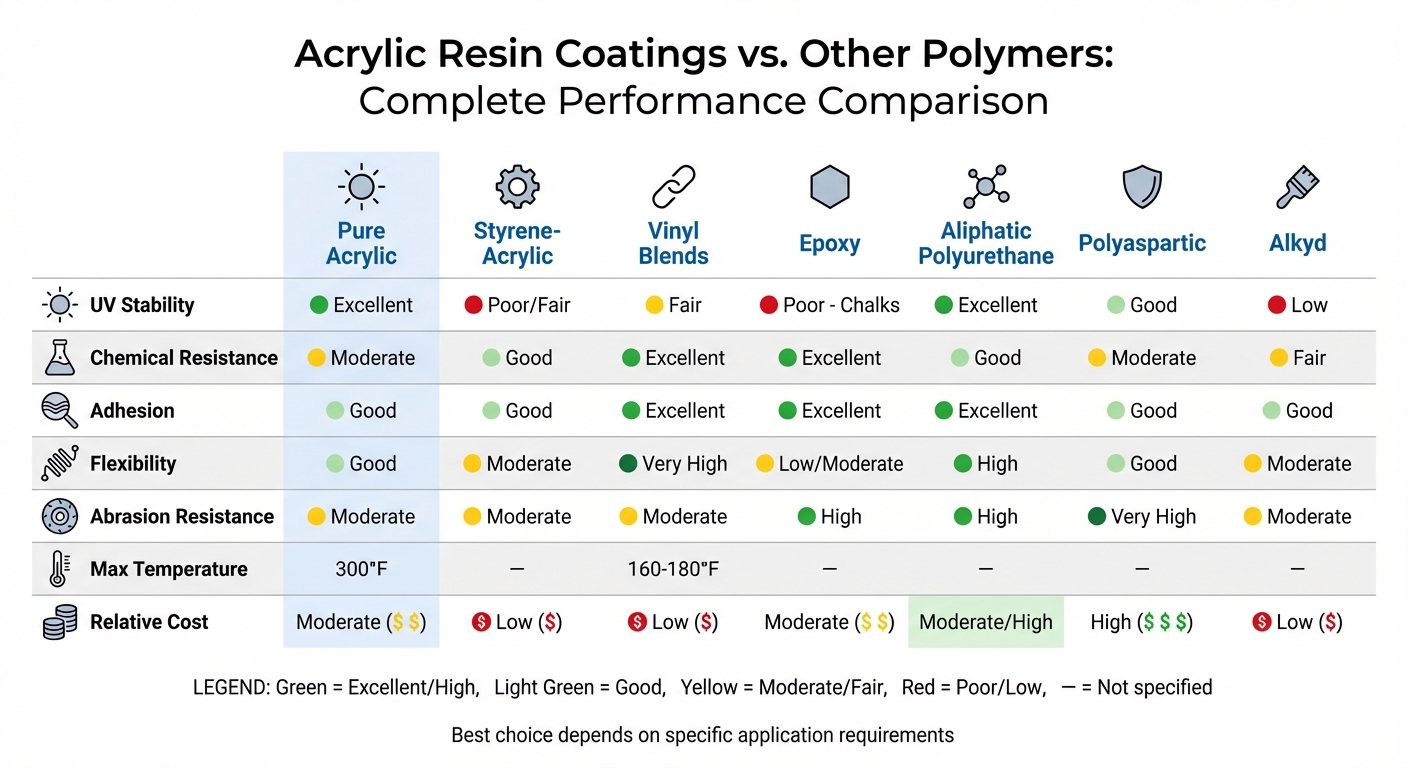
Acrylic Resin Coatings vs Other Polymers: Performance Comparison Chart
Acrylic Resin Coatings vs. Vinyl Polymer Blends
Performance: UV Stability, Adhesion, and Flexibility
When it comes to UV stability, acrylic resins clearly outshine vinyl polymer blends. Acrylic coatings maintain their gloss and color even after extended exposure to sunlight, while vinyl blends – especially those containing styrene or vinyl acetate – tend to yellow and chalk at temperatures above 160°F [2][3][5][7]. Acrylics also demonstrate superior heat resistance compared to their vinyl counterparts [8].
"Styrene monomers are significantly less expensive than acrylic ones… However, styrene-acrylic resins are often subject to yellowing and chalking." – François Magnin, SpecialChem [2]
Adhesion properties differ significantly between the two. Acrylics bond effectively to a variety of surfaces, including metals, plastics, and wood. On the other hand, vinyl-based polymers, particularly those with vinyl acetate, excel in adhering to porous materials [7][8]. This makes vinyl blends a go-to option for adhesives and sealants that demand strong substrate compatibility.
Both systems exhibit strong flexibility, but they achieve it differently. Acrylics offer natural flexibility, which helps prevent cracking during temperature swings. Vinyl-based polymers, such as Ethylene-Vinyl Acetate (EVA), are engineered to deliver high elasticity and resistance to breakage [7][8].
These distinctions in performance directly impact their cost-effectiveness and suitability for specific applications.
Cost and Application Scenarios
Cost considerations also play a crucial role in choosing between these polymers. Vinyl monomers are generally less expensive than acrylic or methacrylate monomers. However, their lower durability and reduced weather resistance can lead to increased maintenance expenses over time [2][5][7].
Application scenarios often dictate which system to use. Pure acrylic resin coatings are ideal for exterior surfaces where retaining color and gloss is critical – think building facades, automotive finishes, or steel structures exposed to direct sunlight [4][6]. Vinyl-modified blends, however, are better suited for indoor projects, industrial primers, or applications where cost and alkali resistance take precedence over UV stability [2]. Keep in mind that waterborne acrylics require ambient temperatures above 41°F (5°C) to prevent film cracking during application [2].
This content is for informational purposes only. Always consult industry professionals and adhere to regulations when making decisions about sourcing or formulations.
sbb-itb-aa4586a
Acrylic Resin Coatings vs. Styrene-Acrylic Polymers
Weather Resistance and Durability
When it comes to weather and water resistance, pure acrylic emulsions stand out. They maintain their color and gloss even after prolonged sun exposure, unlike styrene-acrylic emulsions, which are prone to yellowing over time due to their molecular composition [9][10][11]. The choice between these two materials often boils down to balancing hardness and flexibility. Pure acrylics are known for their flexibility and strong adhesion, while styrene-acrylics incorporate styrene, a "hard monomer", to enhance hardness, abrasion resistance, and rigidity [10].
Styrene-acrylics also bring improved chemical resistance to the table. Thanks to their hydrophobic benzene ring structure, they absorb less water and resist acids, alkalis, and electrolytes effectively. This makes them a great choice for humid or chemically challenging environments [10]. High-quality styrene-acrylic emulsions are expected to perform well in demanding tests, such as showing no chalking after 1,000 hours of QUV accelerated aging and keeping water absorption rates below 5% after 24 hours of immersion [10].
"Generally speaking, in terms of water resistance and weather resistance, pure acrylic emulsion is more excellent than styrene acrylic emulsion." – XZHD Industry [9]
These differences in performance characteristics guide the selection of coatings based on specific environmental and mechanical needs.
Best Applications for Each Polymer
Given their strengths, each polymer has its ideal uses in industrial and commercial settings. Pure acrylic coatings are the go-to choice for high-grade exterior walls, automotive finishes, and projects where long-term color retention and UV resistance are critical [11][12]. These coatings are typically made with acrylic resin concentrations exceeding 90%, which explains their exceptional performance and higher cost [12].
On the other hand, styrene-acrylic polymers are better suited for interior walls, medium-to-low-grade exterior coatings, and industrial applications where hardness and affordability are more important than maximum UV stability [10]. Since styrene monomers are less expensive than acrylic monomers, styrene-acrylic emulsions offer a cost-effective solution while still delivering a balanced performance [2]. For environments with high humidity or chemical exposure, styrene-acrylics shine due to their superior alkali and water resistance [10].
"Pure acrylic ester emulsions offer excellent flexibility, but it lack hardness and durability. Styrene can optimize performance by achieving a balance between hardness and cost." – Jason, Marketing Operations Director & Professional Engineer, iSuoChem [10]
This content is for informational purposes only. Consult official regulations and qualified professionals before making sourcing or formulation decisions.
Acrylic Resin Coatings vs. Epoxy and Polyaspartic Coatings
Durability and Chemical Resistance
When evaluating coatings, it’s essential to weigh durability against ease of application. Epoxy coatings are a popular choice for industrial environments due to their exceptional chemical resistance and mechanical strength, making them ideal for applications like industrial floors and garage decks [1][13]. However, epoxies have a significant drawback: they degrade quickly under UV exposure, leading to yellowing, chalking, and loss of gloss [1][13].
Acrylic resin coatings, on the other hand, shine in their UV stability and color retention. But they offer only moderate resistance to chemicals and abrasion, which may limit their use in heavy-duty flooring or environments with harsh chemicals [1][3][4]. These coatings are typically applied as thin films, with a dry film thickness of 1–3 mils, and can handle temperatures up to 300°F, making them suitable for surfaces like motor housings and process piping [3].
Polyaspartic coatings offer a middle ground, excelling in abrasion resistance and providing high film builds, which are perfect for high-traffic floors [4]. While they perform well in UV stability – better than epoxies – they tend to have weaker resistance to acids [4].
"The major disadvantage of epoxies is their poor exterior durability and moderate abrasion resistance." – Mike Praw, Technical Service & Development Manager at Indorama Ventures [13]
These differences in performance play a critical role in determining which coating is best suited for a specific application.
Application Process and Curing Times
The application and curing requirements vary significantly among these coatings. Acrylic resin coatings are one-component (1K) systems that dry quickly through solvent or water evaporation, making them a convenient choice for DIY projects or fast-turnaround applications, especially on vertical surfaces or areas exposed to UV light [3][13].
Epoxy coatings, in contrast, are more complex. They require a two-component (2K) system and a slower chemical curing process, which often necessitates professional application due to potential health and safety concerns [13].
Polyaspartic coatings, also 2K systems, stand out for their rapid curing times.
"The use of a polyaspartic system can reduce painting schedules to one shift as opposed to several days to allow for proper cure of each coating layer." – Valerie Sherbondy, KTA-Tator, Inc. [4]
However, their fast curing can be a double-edged sword. The short pot life of polyaspartics often requires specialized equipment or smaller batch sizes to prevent the material from hardening before application [4].
This content is for informational purposes only. Always consult official regulations and qualified professionals before making sourcing or formulation decisions.
Acrylic Resin Coatings vs. Alkyd and Polyurethane Resins
UV Stability and Color Retention
When it comes to UV resistance and maintaining color, acrylic resins set the standard for exterior applications. They outperform alkyd resins, which are prone to yellowing and fading over time [14].
Polyurethane coatings show mixed results. Aromatic polyurethanes tend to yellow and chalk under UV exposure, while aliphatic polyurethanes offer much better UV stability. However, the enhanced performance of aliphatic polyurethanes comes at a steep cost [14]. On average, acrylic coatings extend the aesthetic lifespan of surfaces by about 20% compared to aliphatic polyurethanes and 40% compared to aromatic polyurethanes [14].
"Acrylic resins provide excellent weatherability, UV resistance, and color stability, making them ideal for exterior applications." – Patsnap [14]
In the high-performance coating market, acrylic resin systems account for approximately 27% of usage, while polyurethane-based coatings lead with around 38% [14]. These differences in UV performance play a significant role when considering other factors like drying times and specific industrial applications.
Drying Times and Industrial Applications
Acrylic coatings are known for their quick drying times, making them a go-to choice for outdoor projects and high-productivity environments [2]. Alkyd resins, on the other hand, dry at a slower to moderate pace, and traditional two-component polyurethane systems can take up to a week to reach full chemical hardness [15].
Acrylic water-based formulations are also more cost-effective in terms of installation. They require less specialized equipment and ventilation, reducing installation expenses by 10–15%. In contrast, polyurethane systems are 15–30% more expensive and involve handling isocyanates, which require strict safety measures [14].
Despite these advantages, polyurethanes shine in heavy-duty industrial applications where durability is critical. In high-abrasion settings, polyurethane coatings can deliver 2–3 times the wear resistance of acrylics, leading to maintenance cost savings of 25–35% over a five-year period [14]. This makes polyurethane coatings a preferred choice for industrial floors, truck bodies, and chemical processing facilities. Meanwhile, acrylic coatings are better suited for exterior architectural finishes, automotive clearcoats, and decorative projects [1][4][14].
This content is for informational purposes only. Always consult official regulations and qualified professionals before making sourcing or formulation decisions.
Performance Summary Across Applications
Key Differences: Cost, Durability, and Application
Building on earlier comparisons, this section highlights the key performance factors influencing polymer selection. Acrylic resin coatings strike a balance between performance and affordability, making them a practical option for a wide range of uses. Compared to polyurethane systems, acrylics are less expensive while offering impressive UV stability, which can extend their aesthetic lifespan by 20–40% in outdoor environments [14].
For projects where maintaining color and appearance is essential – like exterior architectural work – acrylics outperform epoxies, which tend to chalk and fade under sunlight [4]. On the other hand, industrial applications requiring high durability, such as environments with significant abrasion or chemical exposure, benefit more from polyurethane or epoxy systems. Polyurethane coatings, for example, provide 2–3 times the wear resistance of acrylics, cutting maintenance costs by 25–35% over five years [14].
"Coatings utilizing acrylic resins are the leading polymer technology in the coatings industry." – Ronald Lewarchik, President, Chemical Dynamics [5]
Acrylics also perform well in high-temperature situations, tolerating up to 300°F, making them suitable for uses like motor housings and process piping [3]. For budget-conscious projects, styrene–acrylic blends offer a cost-effective solution. However, they come with trade-offs, such as reduced UV stability and a tendency to yellow when exposed to sunlight [2].
Market trends further illustrate these performance differences. Polyurethane systems dominate with a 38% market share, while acrylic resin systems account for 27% of the $85 billion global high-performance coating market [14]. Among industrial buyers, 73% prioritize coating longevity, while 58% focus on initial cost, highlighting the constant evaluation of upfront expenses versus long-term value [14].
The table below provides a detailed comparison of the key performance characteristics of various polymer types.
Complete Comparison Table
| Polymer Type | UV Stability | Chemical Resistance | Adhesion | Flexibility | Abrasion Resistance | Max Temperature | Relative Cost |
|---|---|---|---|---|---|---|---|
| Pure Acrylic | Excellent | Moderate | Good | Good | Moderate | 300°F | Moderate |
| Styrene–Acrylic | Poor/Fair | Good | Good | Moderate | Moderate | – | Low |
| Vinyl | Fair | Excellent | Excellent | Very High | Moderate | 160–180°F | Moderate |
| Epoxy | Poor (Chalks) | Excellent | Excellent | Low/Moderate | High | – | Moderate |
| Aliphatic Polyurethane | Excellent | Good | Excellent | High | High | – | Moderate/High |
| Polyaspartic | Good | Moderate/Poor (Acids) | Good | Good | Very High | – | High |
| Polysiloxane | Excellent | Good | Good | Good | High | – | High |
| Fluorourethane (FEVE) | Superior (50+ years) | Excellent | Good | High | High | – | Very High |
This information is intended for general guidance. Always consult relevant regulations and professionals before proceeding with sourcing or formulation decisions.
Alkyd, Acrylic, Epoxy and Polyurethane Coating – Understanding the Difference
Conclusion
Acrylic resin coatings have established themselves as a powerful choice in the coatings market, delivering reliable performance, affordability, and adaptability. Their standout features, such as UV stability and resistance to harsh weather, make them particularly suited for exterior architectural projects, automotive finishes, and other applications where maintaining color and appearance over time is essential. Unlike epoxy coatings, which can chalk and yellow under sunlight, or alkyds, which degrade on alkaline surfaces, acrylics hold up remarkably well across a variety of environments.
With their low VOC (volatile organic compound) content, acrylic coatings align with strict regulatory standards, offering manufacturers an environmentally conscious option without sacrificing performance. Additionally, the variety of forms available – thermoplastic, thermoset, and waterborne – provides unmatched versatility for different applications.
Cost efficiency is another major advantage. Acrylic coatings are generally 15–30% less expensive upfront compared to polyurethane systems [14], and their one-component formulations simplify the application process, saving both time and labor costs. While polyurethanes may excel in wear resistance for heavy industrial use, acrylics strike a practical balance, offering sufficient durability for projects where budget constraints and aesthetic quality are priorities.
Advancements in hybrid, bio-based, and nano-structured acrylic formulations continue to expand their capabilities, ensuring that these coatings remain a dependable and cost-effective solution for high-quality applications. Whether you need technical-grade acrylic resins for regulated industries like pharmaceuticals, food, or cosmetics, Allan Chemical Corporation leverages over 40 years of expertise to meet your formulation needs with precision and reliability.
Always consult official regulations and qualified professionals before making sourcing or formulation decisions.
FAQs
What makes acrylic resin coatings a better choice compared to other polymer coatings?
Acrylic resin coatings bring a range of benefits that set them apart from other polymer-based options. Known for their durability, they stand up well against UV radiation, weathering, and chemical exposure, ensuring their color and gloss remain intact over time. Their ability to adhere strongly to surfaces like metal, plastic, wood, and concrete, combined with their flexibility, helps prevent issues like cracking or peeling, even when temperatures fluctuate. These characteristics make them a popular choice for industrial uses and exterior architectural projects.
Although premium acrylic coatings may come with a higher initial price, their extended lifespan and minimal maintenance needs often make them a cost-effective option in the long run. On top of that, water-based acrylics are a more environmentally conscious choice, releasing fewer volatile organic compounds (VOCs) and meeting strict environmental standards. Allan Chemical Corporation provides a broad selection of acrylic resin coatings tailored to meet both high-performance demands and regulatory compliance.
How do acrylic resin coatings compare to polyurethane coatings in terms of cost and durability?
Acrylic resin coatings and polyurethane coatings each bring distinct advantages, depending on where and how they’re used. Acrylic coatings stand out for their durability and ability to handle UV exposure, water, and temperature fluctuations. They also maintain their color over time, making them a great choice for outdoor applications.
In contrast, polyurethane coatings excel in abrasion resistance, chemical resistance, and flexibility. However, they can lose gloss or fade when subjected to prolonged UV exposure.
While the performance traits of these coatings are well understood, detailed cost comparisons are harder to pin down. Prices depend on factors like the specific formulation, how the coating is applied, and the requirements of the project. For accurate pricing tailored to your situation, it’s a good idea to reach out to suppliers or manufacturers directly.
What are the ideal uses for acrylic resin coatings considering their UV resistance and flexibility?
Acrylic resin coatings shine in applications that demand UV stability and flexibility. Their strong resistance to sunlight helps prevent discoloration and degradation, making them an excellent choice for exterior architectural paints, automotive clear coats, and outdoor finishes on metal or wood. These features ensure long-lasting color retention and gloss, even in harsh outdoor conditions.
Their flexibility under thermal or mechanical stress also makes them a top pick for marine coatings, industrial maintenance topcoats, and flooring systems. This adaptability allows the coatings to handle substrate movement, making them reliable in environments with temperature fluctuations or physical stress. Whether it’s outdoor signage, automotive finishes, or industrial uses, acrylic resin coatings deliver durability, UV protection, and reliable performance in demanding settings.


Comments are closed