
Osmolytes are small, water-soluble organic molecules like trehalose, glycerol, and sucrose that stabilize therapeutic proteins in biopharmaceuticals. They protect proteins during manufacturing, storage, and transport by maintaining their folded structure, preventing aggregation, and reducing damage from temperature changes or freeze–thaw cycles. For example, glycerol improves protein stability under thermal stress and acts as a viscosity modifier, while trehalose forms protective glassy matrices in lyophilized formulations. These compounds are essential for ensuring the potency and shelf life of biologics like monoclonal antibodies and vaccines.
Key highlights:
- Primary Function: Stabilize proteins by promoting proper folding and reducing aggregation.
- Applications: Used in vaccines, monoclonal antibodies, and enzyme-based therapies.
- Mechanisms: Work through preferential exclusion, direct interactions, and aggregation prevention.
- Common Osmolytes: Trehalose, sucrose, glycerol, betaine, and sorbitol.
- Formulation Benefits: Extend shelf life, improve thermal stability, and maintain protein activity during stress.
Osmolytes are indispensable for developing stable, reliable biologics, supporting their use in cold-chain logistics and long-term storage.
New solution for high-concentration biologics: How to reduce protein viscosity
Common Osmolytes Used in Protein Stabilization
Biopharmaceutical formulators often turn to specific osmolytes to safeguard therapeutic proteins. Among the most commonly used are trimethylamine N-oxide (TMAO), betaine (glycine betaine), glycerol, trehalose, and sucrose, along with other polyols like sorbitol and glucose [2][3][4]. These compounds are favored due to their high water solubility and their role as "compatible osmolytes", meaning they stabilize proteins without interfering with biological function or causing toxicity at concentrations relevant to formulations [2][5]. Polyols and sugars, in particular, are widely used in marketed biologics, highlighting their importance in maintaining protein stability [2][4]. Below, we explore the stabilization mechanisms and applications of these osmolytes in greater detail.
Trimethylamine N-Oxide (TMAO)
TMAO is a small, highly polar molecule with a zwitterionic structure. It stabilizes proteins by excluding itself from the protein surface, thereby favoring the native folded state and reducing the likelihood of unfolding [3][5]. It is especially effective at countering destabilizing agents like urea, enhancing protein folding and aggregation resistance at moderate concentrations [3][5]. However, its use in commercial formulations is less common compared to sugars and polyols.
One reason for this is that high concentrations of TMAO can destabilize some proteins or lose effectiveness when combined with other cosolutes. For instance, in deep eutectic solvent (DES) studies, TMAO-based formulations preserved only about 20% of lysozyme’s residual activity after heat treatment, while betaine–glycerol or sarcosine–glycerol DESs maintained ≥96–120% activity [1]. Additionally, TMAO faces stricter safety and regulatory hurdles compared to well-established excipients like trehalose or glycerol. As a result, TMAO is more commonly used in research as a reference osmolyte rather than as a primary excipient in commercial products [1][3].
Betaine and Glycerol
Betaine and glycerol, unlike TMAO, remain in bulk water and promote protein stability through preferential hydration. This mechanism shifts equilibrium toward the folded state and strengthens intraprotein hydrogen bonds [2][3][4][5]. Glycerol, in particular, competes with water for hydrogen bonding, weakening protein–water interactions. This results in stronger protein backbone hydrogen bonds, which reduce local unfolding and enhance overall stability [4].
For example, studies using NMR have shown that 160 g/L (~16% w/v) glycerol increases hydrogen-bond coupling by 0.014 Hz, decreases the PDZ3–peptide dissociation constant by 38%, and lowers hydrogen–deuterium exchange rates by 34% [4]. Betaine–glycerol mixtures have demonstrated synergistic effects, enabling lysozyme to retain ≥96–100% residual activity under severe heat and freeze–thaw stress, outperforming TMAO-based systems [1]. In liquid formulations, glycerol is typically used in concentrations ranging from 5–20% w/v (50–200 g/L), where it not only improves thermal stability and reduces aggregation but also serves as a viscosity modifier and tonicity agent [2][4]. These properties make glycerol a mainstay in stabilizing proteins during manufacturing and storage in the U.S. biopharmaceutical industry.
Trehalose and Sucrose
Trehalose and sucrose stabilize proteins through mechanisms such as preferential exclusion, water replacement, and vitrification [2][4][5]. These disaccharides are excluded from the protein surface, promoting the compact native state and reducing the likelihood of unfolding [2][5]. When proteins are dried or frozen, these sugars replace water molecules around polar groups, creating a protective hydrogen-bonding network that preserves native-like conformations in the absence of bulk water [5].
In solid or highly viscous states, trehalose and sucrose form glassy matrices with high glass-transition temperatures (Tg). These matrices immobilize protein molecules, reduce molecular mobility, and significantly slow down aggregation and degradation during thermal stress or long-term storage [2][5]. Trehalose is widely used in commercial biologics, including Herceptin (trastuzumab), Avastin (bevacizumab), Lucentis (ranibizumab), and Advate (antihemophilic factor), as a stabilizing excipient [4].
In liquid protein formulations, sucrose or trehalose is commonly used in the 5–10% w/v range to stabilize proteins and contribute to tonicity. For lyophilized products, higher sugar-to-protein ratios are employed to ensure the formation of an amorphous glass and adequate water replacement [2][5]. These sugars are pharmacopeial-grade, thoroughly characterized, and widely accepted by regulatory bodies. U.S.-based suppliers, such as Allan Chemical Corporation, provide trehalose and sucrose in USP or other compendial grades suitable for use in injectable biologics.
This content is for informational purposes only. Always consult official regulations and qualified professionals before making sourcing or formulation decisions.
How Osmolytes Stabilize Protein Structure
Osmolytes play a crucial role in protecting therapeutic proteins by employing three interconnected mechanisms: preferential exclusion from the protein surface, direct molecular interactions, and their impact on aggregation and thermal stability. Together, these processes help maintain protein integrity throughout manufacturing, storage, and transportation.
Preferential Exclusion Mechanism
The preferential exclusion mechanism is one of the primary ways osmolytes stabilize proteins in formulations, often using top stabilizers for protein-based biopharmaceuticals. Osmolytes such as trehalose, sucrose, glycerol, and betaine are kept away from the immediate protein surface, remaining concentrated in the surrounding bulk solution instead [2][5]. This exclusion makes unfolded protein states – where more surface area is exposed – less energetically favorable, thereby encouraging the protein to stay in its compact, folded state. This shift in equilibrium also increases the energy required for the protein to unfold [2][5].
Additionally, this mechanism alters the protein–water hydrogen-bond network. By strengthening protein–protein hydrogen bonds and weakening protein–solvent interactions, it enhances the thermal stability and shelf-life of vaccines and antibodies [2][4][5]. Beyond this exclusion effect, osmolytes also stabilize proteins through direct molecular interactions, which are discussed next.
Direct Binding Interactions
Some osmolytes stabilize proteins not just by exclusion but also by directly binding to protein sites. These interactions may involve hydrogen bonds, ionic contacts, or hydrophobic interactions [3][4][5]. For instance, sugars can form protective hydrogen-bonding networks with surface residues, reducing local flexibility, while polyols may bridge charged side chains to provide additional stability [4][5].
However, this approach has its risks. If osmolytes bind too strongly to exposed hydrophobic areas on partially unfolded proteins, they can stabilize undesirable intermediate states or even promote aggregation [3][5]. This dual nature makes it essential for formulation scientists to carefully evaluate osmolyte–protein combinations using methods such as differential scanning calorimetry (DSC), circular dichroism (CD), nuclear magnetic resonance (NMR), or dynamic light scattering (DLS) [2][3]. The goal is to find conditions where direct osmolyte–protein interactions enhance stability without compromising the protein’s biological activity or triggering unwanted associations. When optimized, these interactions work alongside preferential exclusion to reduce aggregation and improve thermal stability.
Effects on Aggregation and Thermal Stability
Osmolytes help prevent protein aggregation through several mechanisms. They stabilize the native protein structure, increase the energy barrier for exposing hydrophobic regions, and adjust solution properties like viscosity and excluded volume to discourage protein–protein interactions [2][3][5]. By reducing the likelihood of aggregation-prone intermediates and minimizing local unfolding events, osmolytes act much like molecular chaperones [1][5].
Stress studies highlight these benefits. Formulations containing combinations like sarcosine with glycerol or betaine with glycerol have shown high residual activity even under extreme thermal stress and freeze–thaw cycles. In contrast, significant activity loss was observed in reference buffers where aggregation was more pronounced [1]. These improvements often correspond to increases in the melting temperature (Tm) of 5–18°F (3–10°C) or more, depending on the protein and osmolyte concentration [2][4][5]. For biologics stored under refrigerated conditions in the U.S. (36–46°F or 2–8°C), these gains directly translate into longer shelf-life and fewer subvisible particles during storage and transportation [1][2].
This content is for informational purposes only. Always consult official regulations and qualified professionals before making sourcing or formulation decisions.
sbb-itb-aa4586a
Practical Uses of Osmolytes in Biopharmaceutical Formulations
Osmolytes play a key role in stabilizing proteins, ensuring their viability during manufacturing, storage, and distribution.
Protein-Based Therapeutics
Osmolytes like trehalose, sorbitol, and arginine are widely used in protein-based therapeutics to prevent aggregation and misfolding during purification and processing. These issues often arise from pH changes, shifts in concentration, or shear stress, but osmolytes help maintain proteins in their native, functional state, reducing material loss during manufacturing[2][3].
In the final formulations, osmolytes serve multiple purposes: stabilizing proteins, acting as bulking agents, and providing buffering support. Sugars and polyols are especially common in commercial biologics to ensure stability and meet formulation requirements[2][4]. For lyophilized drugs, trehalose is often used in high concentrations (tens to hundreds of mg/mL) to create a protective glass-like matrix and maintain isotonicity. Sucrose and mannitol are frequently combined – sucrose provides stabilization, while mannitol supports the structural integrity of the cake. In liquid formulations, glycerol and sorbitol are typically used in low single-digit percentages (w/v) to protect against freezing and heat stress without significantly increasing injection viscosity.
Formulation scientists carefully select osmolytes to meet strict pharmacopoeial standards, ensuring a shelf life of at least 24 months while maintaining acceptable viscosity and osmolality levels (usually 280–320 mOsm/kg for intravenous or subcutaneous delivery). Suppliers like Allan Chemical Corporation offer USP, FCC, and ACS-grade osmolytes, supporting compliance with cGMP manufacturing and regulatory standards in the U.S.
Osmolytes also play a critical role in stabilizing vaccines, further expanding their importance in biopharmaceutical applications.
Vaccine Stabilization
In vaccine formulations, osmolytes protect protein antigens and adjuvant–antigen complexes from thermal and mechanical stresses encountered during distribution and use. During freeze-drying and cold-chain storage, trehalose and sucrose form a glassy matrix that preserves the native structure of antigens by strengthening hydrogen bonds and reducing conformational fluctuations[4].
This protection helps vaccines endure occasional freezing or brief temperature increases (68–77°F or 20–25°C) during handling. For multi-dose vials, which are often punctured and agitated repeatedly, osmolytes minimize visible and subvisible particle formation, ensuring both potency and compliance with particulate limits.
Beyond formulation, osmolytes are equally important in maintaining the stability of biopharmaceuticals during storage and transport.
Biopharmaceutical Storage and Transportation
Osmolytes help mitigate the mechanical and thermal stresses that biologics face during storage and transportation. Under standard U.S. refrigerated conditions (36–46°F or 2–8°C), they stabilize protein structures, reducing risks of denaturation and aggregation. They also provide protection against short-term temperature fluctuations or agitation during preparation for injection.
These protective effects often translate into increased protein melting temperatures (Tm) by approximately 5–18°F (3–10°C), depending on the protein and osmolyte concentration[1][2][4]. In high-concentration antibody formulations used in prefilled syringes or autoinjectors, arginine is commonly employed at concentrations ranging from tens to hundreds of mM to prevent self-association and aggregation without affecting biological activity[2][3].
Developers in the U.S. can optimize osmolyte use through stress testing and accelerated stability studies. Key formulation parameters include protein stability (evaluated using techniques like differential scanning calorimetry and aggregation assays), osmolality, pH, buffering capacity, and compatibility with excipients and container systems. Using USP/NF or ACS-grade osmolytes simplifies regulatory processes and ensures the stability of biopharmaceuticals[2][4].
This content is for informational purposes only. Always consult official regulations and qualified professionals before making sourcing or formulation decisions.
Comparing Osmolyte Performance
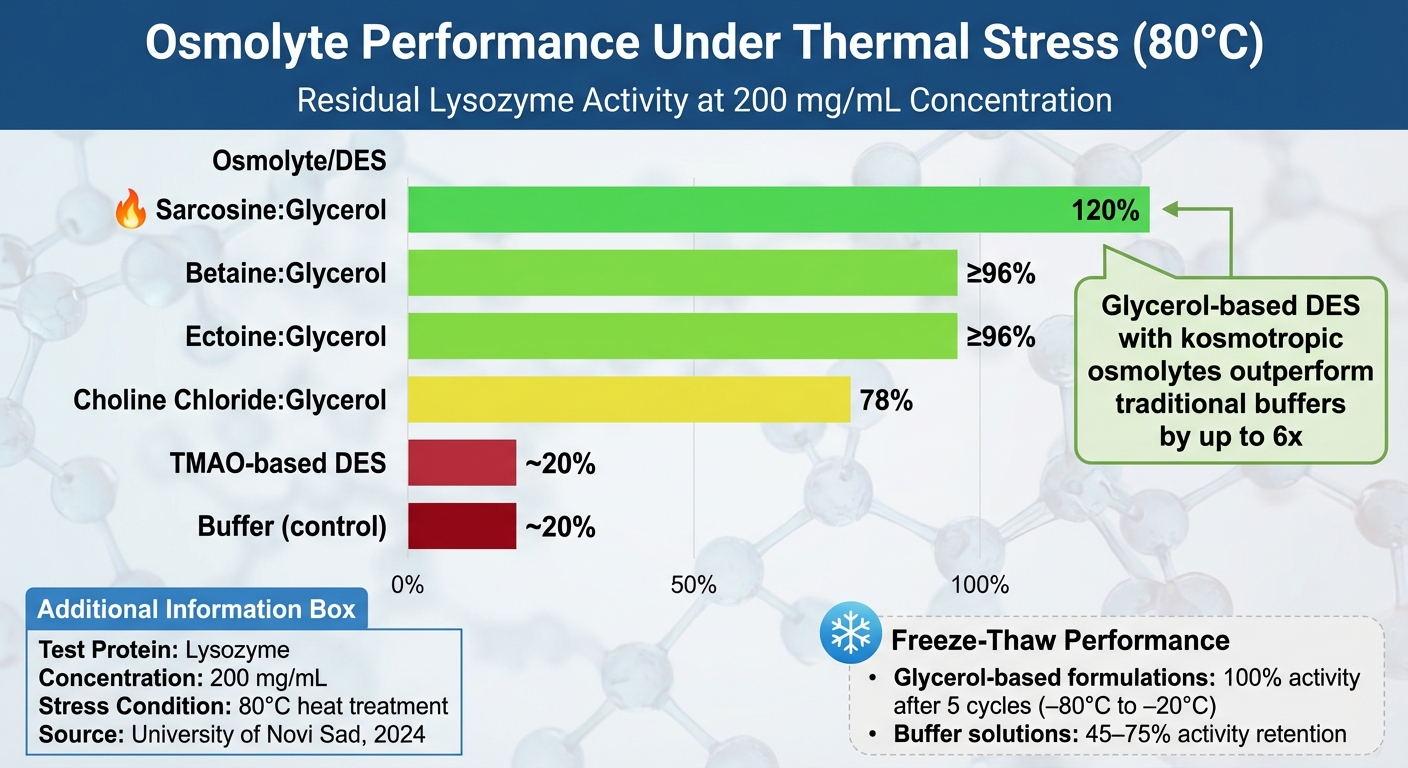
Osmolyte Performance Comparison Under Thermal Stress
Stabilization Strength Comparison
Let’s dive into how different osmolytes perform under stress conditions. Research shows that glycerol-based deep eutectic solvents (DES) vs. ionic liquids, when paired with kosmotropic osmolytes like sarcosine, betaine, or ectoine, consistently outperform traditional single-osmolite solutions. A 2024 study from the University of Novi Sad tested lysozyme at high concentrations (200 mg/mL) under thermal stress at 80°C, offering some fascinating insights[1].
For instance, sarcosine–glycerol DES achieved an impressive 120% residual activity after heat stress. Betaine–glycerol and ectoine–glycerol combinations weren’t far behind, maintaining at least 96% activity. In stark contrast, TMAO-based DES and control buffers only retained about 20% activity[1]. Beyond thermal stress, these glycerol-based formulations also excelled during freeze–thaw cycles. Remarkably, they preserved 100% activity after five cycles between –80°C (≈ –112°F) and –20°C (≈ –4°F), whereas buffer solutions only retained 45–75% activity under the same conditions[1].
Here’s a quick summary of the results:
| Osmolyte/DES | Protein | Stress Condition | Residual Activity |
|---|---|---|---|
| Sarcosine:Glycerol | Lysozyme | 80°C heat | 120% |
| Betaine:Glycerol | Lysozyme | 80°C heat | ≥96% |
| Ectoine:Glycerol | Lysozyme | 80°C heat | ≥96% |
| Choline Chloride:Glycerol | Lysozyme | 80°C heat | 78% |
| TMAO-based DES | Lysozyme | 80°C heat | ~20% |
| Buffer (control) | Lysozyme | 80°C heat | ~20% |
These results highlight the effectiveness of glycerol-based DES in stabilizing proteins under extreme conditions, setting the foundation for broader applications.
Case Study Examples
The performance of osmolytes isn’t just theoretical – it’s reflected in real-world applications. Trehalose, for example, is a staple in U.S. biopharmaceutical formulations. It plays a critical role in stabilizing blockbuster antibody therapeutics like Herceptin®, Avastin®, and Lucentis®, as well as clotting factor products such as Advate®[4]. Trehalose works through preferential exclusion, which encourages water molecules to stay near protein surfaces, reducing the risk of protein unfolding during storage or transport.
Building on this, researchers at the University of Novi Sad demonstrated that multicomponent bioinspired DES – combining betaine, TMAO, urea, and glycerol – achieved over 85% residual activity after stress testing. This was a clear improvement over simpler two-component formulations. Toxicity tests on cell lines like Caco-2, HaCaT, and HeLa further confirmed that these DES formulations are non-toxic at working concentrations, making them viable for pharmaceutical applications[1].
These findings underscore the importance of choosing the right osmolyte based on specific protein properties and stress challenges, much like how manufacturers select excipients for biosimilars to ensure long-term stability. Glycerol-based DES stand out for thermal and freeze–thaw stress, while trehalose remains a trusted choice for long-term stability in both lyophilized and liquid forms. For those needing high-quality osmolytes, providers like Allan Chemical Corporation offer a wide range of technical- and compendial-grade products designed to meet cGMP standards, streamlining regulatory compliance.
This content is for informational purposes only. Always consult official regulations and qualified professionals before making sourcing or formulation decisions.
Conclusion
Osmolytes play a crucial role in biopharmaceutical formulations by stabilizing protein structures and preventing aggregation during manufacturing, storage, and distribution. Between 1998 and 2017, many FDA-approved biologics incorporated osmolytes like trehalose, sucrose, glycerol, sorbitol, and betaine to extend shelf life and ensure consistent dosing performance[2][4]. These compounds work by maintaining proteins in their compact, native state while minimizing denaturation caused by thermal stress, freeze–thaw cycles, and handling conditions[2][5].
The importance of selecting the right osmolyte cannot be overstated. For example, glycerol-based formulations have shown significantly better stability under stress compared to traditional buffers[1]. Trehalose remains a cornerstone for stabilizing antibody therapeutics in the U.S. market, and innovative multicomponent systems are emerging as promising solutions for high-concentration formulations under extreme conditions. However, osmolyte selection is not a one-size-fits-all process. Formulators must carefully evaluate candidates through stress studies, analytical methods, and regulatory guidelines to weigh stabilization benefits against potential drawbacks, such as increased viscosity or altered osmolality[2][1].
Advancements in osmolyte-based deep eutectic solvents are paving the way for next-generation biologics, gene therapies, and vaccine antigens[3][4]. To meet these evolving needs, manufacturers rely on high-purity, compendial-grade osmolytes. Companies like Allan Chemical Corporation support this effort by providing USP, FCC, ACS, and NF-grade sugars, polyols, and amino-acid–derived osmolytes. Their materials, backed by stringent quality systems, ensure consistent supply and reliability for both development and commercial-scale production.
By optimizing osmolyte use, manufacturers can enhance protein stability, leading to safer and more effective biotherapeutics. This means more consistent medicines, fewer immunogenic aggregates, and longer shelf lives, ensuring patients have reliable access to high-quality treatments[2][4]. Through careful formulation and the use of high-grade osmolytes, manufacturers can mitigate degradation and potency loss, even under the demanding conditions of cold-chain logistics and clinical environments.
This content is for informational purposes only. Always consult official regulations and qualified professionals before making sourcing or formulation decisions.
FAQs
What role do osmolytes play in stabilizing therapeutic proteins in biopharmaceutical formulations?
Osmolytes are essential for preserving the stability of therapeutic proteins, ensuring they maintain their correct folded structure. They act as a safeguard against protein aggregation and shield proteins from stress-induced denaturation triggered by factors such as temperature shifts, pH variations, or dehydration.
This ability to stabilize proteins plays a key role in extending the shelf life and maintaining the effectiveness of biopharmaceutical formulations, supporting consistent quality and reliable performance.
How do trehalose and glycerol differ in their roles and benefits for protein stabilization?
Trehalose helps protect proteins by substituting for water molecules and forming a protective, glass-like structure. This process offers strong thermal and oxidative stability, shielding proteins from damage caused by heat stress.
Glycerol takes a different approach by increasing solution viscosity and limiting molecular movement. This action prevents proteins from unfolding or clumping, particularly during freezing and drying stages. While trehalose is best suited for stabilizing proteins under heat, glycerol shines as a cryoprotectant, preserving protein functionality in cold conditions.
Why isn’t TMAO used as often as trehalose or glycerol in biopharmaceutical formulations?
TMAO sees limited use in biopharmaceutical formulations, primarily because of challenges in handling and stabilization. Its safety and efficacy profile is also narrower compared to osmolytes like trehalose and glycerol, which are widely recognized and supported by extensive research and regulatory approval.
Trehalose and glycerol are the go-to options for most commercial applications, thanks to their proven ability to stabilize proteins and preserve formulation integrity.




Comments are closed