
Macrocyclic musks are synthetic fragrance compounds with 12–18 atom rings, designed to replicate the scent of natural musks like Muscone (CAS No. 541-91-3). These compounds are widely used in perfumes and personal care products for their clean, warm, and skin-like aroma. Unlike older nitro or polycyclic musks, macrocyclic musks degrade faster, avoiding environmental buildup.
Key production steps include:
- Choosing the structure: Typically, 15–17-membered rings are preferred for their balance of scent and stability.
- Synthesis methods: Ring-closing metathesis (RCM) is a common technique using ruthenium catalysts, while classical methods like lactonization are also used for certain musks.
- Purification: Techniques such as distillation and chromatography ensure high-purity products, often exceeding 98% purity for fragrance-grade applications.
Producing macrocyclic musks requires precise chemistry, quality control, and adherence to regulatory standards for synthetic fragrances, ensuring safe and consistent products for use in cosmetics and home fragrances.
Planning the Synthesis Process
Choosing Target Structures
When designing musk fragrances, perfumers and chemists often focus on 15–17-membered macrocyclic rings. These specific ring sizes tend to deliver the desired musk character while balancing volatility and staying power on skin and fabrics. Macrocyclic ketones, like muscone and civetone, are known for their animalic and sensual notes, offering high lipophilicity and strong fixative properties. On the other hand, macrocyclic lactones, such as exaltolide, lean toward creamier profiles with subtle fruity or floral undertones, depending on the ring size and substitution pattern. Small structural tweaks – like changing the ring size, introducing unsaturation, or adding heteroatoms – can significantly alter the fragrance’s quality. To predict musk potency, chemists often rely on conformational analysis and odor modeling before committing to complex multi-step synthesis.
An essential early step in the process is screening potential structures against regulatory standards. This helps avoid investing time and resources in molecules that may later fail to meet U.S. safety requirements.
Common Synthesis Methods
Ring-closing metathesis (RCM) is a preferred method for macrocyclization due to its versatility. It tolerates a wide range of functional groups, allows for shorter precursor molecules, and eliminates the need for the extreme dilution conditions required by older techniques. Using ruthenium-based catalysts, chemists can cyclize dienic precursors to produce macrocyclic lactones or ketones in fewer steps, as seen in the synthesis of exaltolide and other musk lactones.
Classical methods, such as lactonization and depolymerization, remain valuable, especially for macrocyclic lactones like cyclopentadecanolide. These approaches often involve polymerizing ω-hydroxy acids followed by controlled depolymerization and can be more cost-effective when suitable feedstocks are available.
A critical decision in synthesis planning is choosing between batch and continuous-flow setups for macrocyclization. Batch RCM typically achieves higher yields over longer durations and requires simpler equipment. In contrast, continuous-flow processes offer faster reaction times, improved thermal control, and safer handling of catalysts and intermediates at scale, though yields may be more moderate. The choice between these methods often shapes the selection of raw materials and reagents.
Raw Material and Reagent Selection
In RCM-based synthesis, the choice of ruthenium catalysts is crucial. Chemists aim to balance activity, stability, and cost while ensuring minimal residual metal content in the final product. Solvents like toluene or ethyl acetate must meet criteria for flammability, VOC regulations, and ease of removal. There is also a growing push for greener, less toxic alternatives. Increasingly, feedstocks are sourced from renewable or bio-based materials, such as fatty acid derivatives and seed oils, to align with sustainability goals and consumer preferences. For example, a patented process for cyclopentadecanolide production uses Malania oleifera oil as a starting material, extracting C15 fatty acid components through hydrolysis and selective transformations.
In the U.S., raw materials must meet stringent quality standards, such as USP, FCC, ACS, or NF grades, with detailed documentation like Specifications, Certificates of Analysis, and Safety Data Sheets. Allan Chemical Corporation supports regulated industries by supplying technical- and compendial-grade reagents, catalysts, and solvents. Their just-in-time delivery model and strong supplier relationships ensure compliance with EPA, TSCA, OSHA, and FDA regulations. At the production scale, engineers evaluate factors like overall yield, cycle time, catalyst cost and recyclability, solvent efficiency, and ease of workup to optimize commercial viability. The quality of catalysts and feedstocks directly impacts the process’s performance and efficiency.
This content is for informational purposes only. Consult official regulations and qualified professionals before making sourcing or formulation decisions.
How to Produce Macrocyclic Lactones
Preparing the Linear Precursor
Producing macrocyclic lactone musks begins with synthesizing a linear diolefinic or ω‑alkenyl ester, typically containing 14 to 18 carbon atoms. These chains are the building blocks for 15‑ to 17‑membered rings. Manufacturers often use long‑chain fatty acids or diols derived from plant oils. For instance, cyclopentadecanolide – a widely used 15‑membered musk lactone – can be made from renewable sources by converting fatty acids into ω‑hydroxy derivatives and functionalizing them to introduce terminal alkenes for ring‑closing metathesis [6].
The process starts by activating the fatty acid, converting it into a methyl ester or acid chloride. Terminal double bonds are then introduced through reactions like ω‑bromination–elimination or the Wittig reaction. Careful control of olefin geometry (E/Z ratios) is essential, while avoiding over‑oxidation or side‑chain cleavage [2]. For diolefinic diesters, esterifying an ω‑alkenyl alcohol with an ω‑alkenyl acid derivative positions two terminal double bonds for efficient macrocyclization. After synthesis, impurities such as inorganic salts and residual reagents are removed through filtration, aqueous washes, and drying.
Before proceeding to metathesis, the precursor’s identity and purity are verified using techniques like GC–MS, LC–MS, NMR, and Karl Fischer titration to ensure water content remains at or below 0.05–0.1% w/w. Residual metals and halides must also be minimized [2]. Fragrance‑grade precursors are held to high standards, requiring more than 95–98% GC purity with controlled isomer distribution. U.S. buyers often request Certificates of Analysis and supporting data that align with USP or ACS guidelines [4]. This meticulous preparation ensures a controlled and efficient ring‑closing metathesis reaction.
Running the Metathesis Reaction
Ring‑closing metathesis (RCM) is performed using ruthenium-based catalysts like Grubbs or Hoveyda–Grubbs catalysts. First-generation Grubbs catalysts are more cost-effective but less active, while second-generation and Hoveyda–Grubbs catalysts offer better performance, especially for larger rings [5]. On a lab scale, catalyst loadings range from 1–5 mol%, but for large-scale production, this can be reduced to just hundreds of ppm, which is critical for high-volume manufacturing of compounds like Exaltolide [2].
The reaction is conducted under highly dilute conditions – typically in the low millimolar range – to encourage intramolecular closure and avoid oligomerization. Solvents like dichloromethane or toluene are used, with toluene being the preferred choice for its cost and safety advantages in larger operations [5]. Temperature control is key, with batch processes typically running between 20–80°C to maximize selectivity. Reaction times can vary significantly; for example, a renewable macrocyclic musk achieved a 57% yield at room temperature over five days, while a continuous-flow process at 150°C delivered a 32% yield in just five minutes [5]. Ruthenium catalysts require an inert atmosphere, such as nitrogen or argon, during handling and the early stages of the reaction [2].
Scaling up requires strict adherence to safety and environmental standards. Closed, inerted reactors equipped with temperature controls, inline GC or IR monitoring, and proper venting systems are used to comply with OSHA and EPA regulations. Handling ruthenium catalysts and chlorinated or aromatic solvents also necessitates local exhaust ventilation, personal protective equipment, and proper hazardous-waste management. U.S. buyers often rely on suppliers like Allan Chemical Corporation, which specialize in managing hazardous materials, solvent recovery, and efficient supply chains for the cosmetics and fragrance industries [4]. Once the metathesis reaction is complete, attention shifts to quenching and purifying the product to meet fragrance-grade standards.
Purification and Finishing Steps
After the reaction, the catalyst must be quenched and residual metals removed. The mixture is cooled and treated with scavengers – such as phosphines, thiols, or metal-scavenging resins – to bind and eliminate ruthenium complexes [2]. Additional purification can be achieved through aqueous extraction and filtration using silica, alumina, or functionalized resins. For modern fragrance and cosmetic applications, residual metal levels must be reduced to ppm or even low-ppb ranges, verified by ICP-OES analysis.
Solvent recovery is another important step, typically carried out using distillation systems equipped with proper condensation and emissions control to meet environmental and cost considerations [5]. Final purification of the macrocyclic lactone involves fractional distillation under reduced pressure due to the high boiling points of these compounds. Chromatography is generally reserved for development or high-value, low-volume materials. Purity is confirmed through GC–MS and HPLC analysis, and the final product undergoes odor evaluation by expert sensory panels to ensure consistent fragrance quality and regulatory compliance [2]. The resulting high-purity musk lactone is then ready for use in perfumes, personal-care products, and household fragrances.
This content is for informational purposes only. Consult official regulations and qualified professionals before making sourcing or formulation decisions.
Synthesis of Macrocyclic Molecules (Macrocycles)
sbb-itb-aa4586a
How to Produce Macrocyclic Ketones
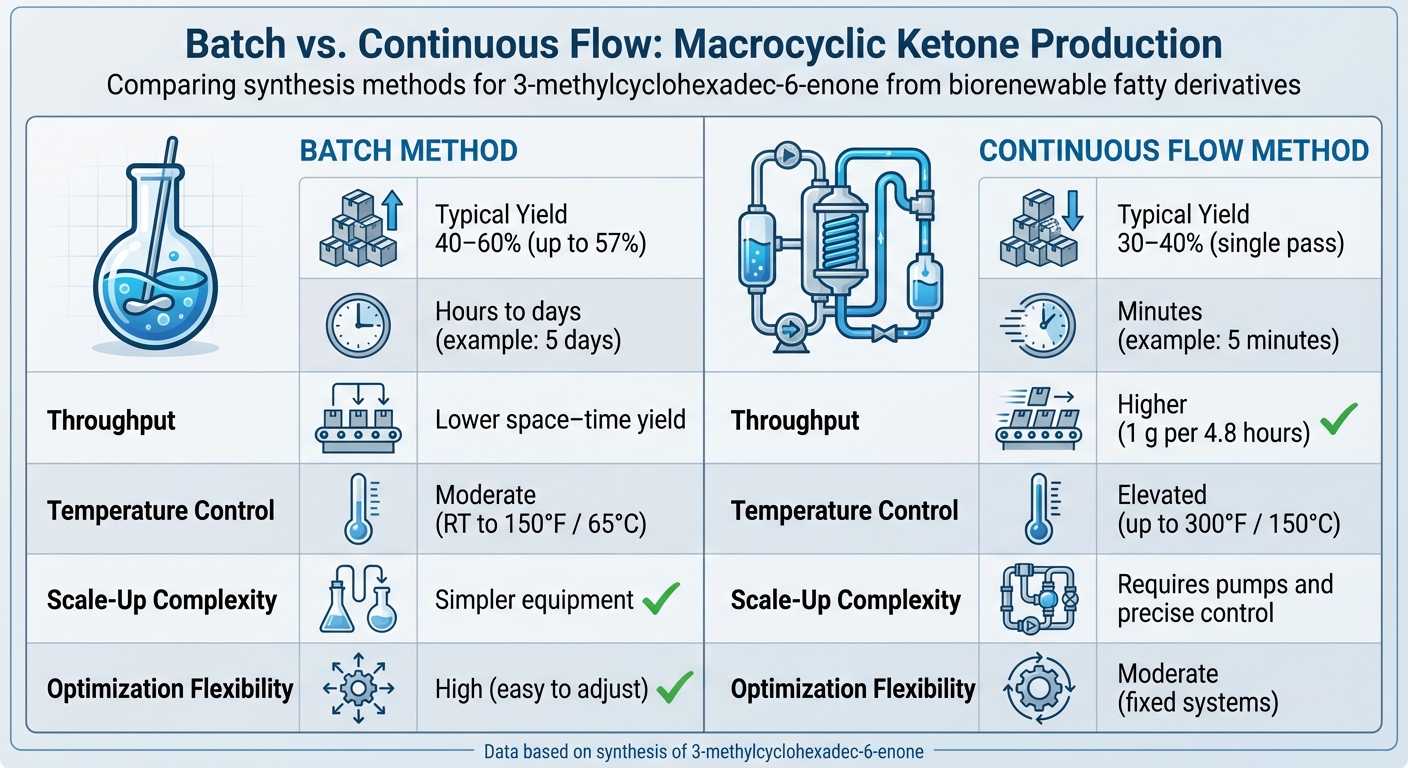
Batch vs Continuous Flow Macrocyclic Ketone Production Comparison
Macrocyclic ketones, such as muscone and civetone, are crafted by first creating a long linear chain containing a ketone and terminal olefins. This chain is then closed into a ring via metathesis. Producing fragrance-grade ketones requires precise precursor preparation and carefully controlled reaction conditions.
Crafting the Linear Ketone Precursor
Linear ketone precursors are typically derived from C14–C18 fatty derivatives. A ketone group is introduced through controlled oxidation or acylation, while terminal olefins are added using methods like Wittig or Tebbe olefination. Precision in oxidation and controlling isomer formation is essential to avoid issues like catalyst deactivation or unpleasant odors. To ensure purity, techniques such as fractional distillation, chromatography, or crystallization are employed to eliminate oligomers, metal residues, and isomeric dienes. High-purity precursors are vital for consistent yields and clean odor profiles, especially for fragrance applications in the U.S. Additionally, minimizing metal contaminants helps maintain catalyst activity during the ring-closing step.
Batch vs. Continuous Flow Methods
The macrocyclization of linear ketone precursors can be accomplished using either batch or continuous flow processes. Batch reactions occur in stirred vessels under high dilution, using catalysts like Grubbs second-generation or Hoveyda–Grubbs ruthenium complexes.
A direct comparison of these methods highlights their trade-offs. For instance, 3-methylcyclohexadec-6-enone was synthesized from a biorenewable fatty derivative using both approaches. The batch process, conducted at room temperature, took 5 days to achieve a 57% isolated yield. In contrast, the continuous flow method, operating at 300 °F (150 °C), completed the reaction in just 5 minutes but yielded 32% with a throughput of 1 gram every 4.8 hours [5]. This example underscores the primary differences: batch processes offer higher yields and greater flexibility for optimization, while continuous flow significantly reduces reaction times and improves throughput.
Here’s a quick comparison of the two methods:
| Parameter | Batch | Continuous Flow |
|---|---|---|
| Typical Yield | 40–60% (up to 57%) | 30–40% (single pass) |
| Reaction Time | Hours to days (e.g., 5 days) | Minutes (e.g., 5 min) |
| Throughput | Lower space–time yield | Higher (e.g., 1 g per 4.8 h) |
| Temperature Control | Moderate (RT to 150 °F) | Elevated (up to 300 °F) |
| Scale-Up Complexity | Simpler equipment | Requires pumps and precise control |
| Optimization Flexibility | High (easy to adjust) | Moderate (fixed systems) |
Refinement and Odor Tuning
After metathesis, further steps refine the macrocyclic ketone, similar to lactone purification. The catalyst is deactivated using scavenger resins or polar adsorbents, followed by liquid–liquid extraction and filtration through silica or activated carbon to remove metal residues and colored impurities. Fractional distillation under reduced pressure ensures the final product’s purity.
Hydrogenation is often used to adjust unsaturation, fine-tuning the musk character. Modifications such as double-bond isomerization or slight changes in ring size (e.g., 15, 16, or 17 members) can greatly influence the intensity, diffusion, and longevity of the scent on skin or fabric. Synthetic programs frequently produce a range of related macrocyclic ketones, testing them with sensory panels and analytical tools like GC–MS and HPLC to identify the ideal structure for the desired musk profile.
The final product must meet stringent standards, including high chemical purity (often over 98%) and minimal heavy metal content, verified through methods like ICP-OES. These requirements ensure compliance with U.S. regulations for cosmetics and fragrances. Specialty suppliers, such as Allan Chemical Corporation, offer macrocyclic ketones and intermediates in technical or compendial grades (USP, ACS, NF), backed by rigorous quality systems to ensure consistent performance and regulatory compliance in personal-care and home-care products.
This information is provided for educational purposes. Always consult official regulations and qualified professionals for sourcing or formulation decisions.
Quality Control, Safety, and Supply Chain
Analytical and Sensory Testing
Ensuring the quality of musk materials involves both advanced instrumental techniques and sensory evaluations. Tools like gas chromatography (GC) and GC–mass spectrometry (GC–MS) are critical for identifying chemical profiles, measuring active ingredients, and detecting impurities or signs of oxidation in musk samples [3]. High-performance liquid chromatography (HPLC) is commonly used to analyze components that are either non-volatile or sensitive to heat, as well as for impurity profiling during fragrance and cosmetic quality checks [3]. After processes like metathesis and purification, nuclear magnetic resonance (NMR) spectroscopy (¹H, ¹³C, 2D) is employed to confirm the molecular structure and stereochemistry of macrocyclic lactones and ketones. This step ensures that no isomeric impurities compromise the intended scent [1][2].
While analytical methods provide precise data, sensory panels remain indispensable. Techniques like sniff tests, triangle tests, and descriptive profiling ensure that the analytical purity translates into the desired odor characteristics, including strength, diffusion, and longevity. Odor consistency depends on factors such as isomer ratios, ring size, and stereochemistry. By maintaining a reference standard for the odor profile and routinely testing production batches, manufacturers can detect and address issues like off-notes, oxidation, or diminished diffusion. These evaluations play a crucial role in upholding regulatory standards and safe manufacturing practices.
Regulatory Compliance and Safety Protocols
In the U.S., macrocyclic musks used in cosmetics are regulated by the FDA under the Federal Food, Drug, and Cosmetic Act (FD&C Act). These materials must be proven safe for their labeled or customary uses [3]. Additionally, the International Fragrance Association (IFRA) establishes usage limits and purity requirements for many fragrance components, including macrocyclic musks. Even musks considered safer must comply with these standards when incorporated into finished products. On the workplace safety front, OSHA’s Hazard Communication Standard requires manufacturers to provide Safety Data Sheets (SDS), proper labeling, and training for employees handling musk intermediates, catalysts, and solvents. Furthermore, EPA regulations under the Toxic Substances Control Act (TSCA) mandate that musk ingredients either be listed on the TSCA Inventory or undergo pre-manufacture notifications when produced at an industrial scale.
Good manufacturing practices are essential for maintaining safety. This includes using proper ventilation, closed transfer systems, and personal protective equipment (PPE). For example, nitrile gloves, splash goggles, and flame-resistant lab coats are standard requirements for handling volatile substances. Monitoring systems for flammable vapors, such as those from toluene, hexane, or ethanol, and adherence to NFPA guidelines for explosion-proof equipment are critical for protecting both workers and facilities. These precautions ensure that the final macrocyclic musk products meet the required performance and regulatory standards.
Working with Specialty Suppliers
A dependable supply chain is vital for ensuring compliance and maintaining product quality. Reliable suppliers provide high-purity macrocyclic musk intermediates and supporting chemicals, along with the necessary regulatory documentation. Strategies like supplier verification, second-sourcing, and strong contractual agreements help mitigate risks related to supply disruptions for key materials, catalysts, and solvents [4][5]. Vetting suppliers based on their quality management systems, regulatory expertise, and track record for on-time delivery minimizes issues related to quality and availability [4].
For instance, Allan Chemical Corporation stands out as a trusted partner in specialty chemical sourcing. They offer technical- and compendial-grade products (USP, FCC, ACS, NF) accompanied by thorough regulatory documentation. Their just-in-time delivery model helps manufacturers reduce inventory costs and avoid production delays. By fostering strong supplier relationships, they ensure consistent access to high-purity materials and regulatory support. This approach enables manufacturers to maintain the quality of musk products while meeting regulatory requirements for personal-care and home-care applications.
This content is for informational purposes only. Consult official regulations and qualified professionals before making sourcing or formulation decisions.
Conclusion
Creating top-tier macrocyclic musks demands thoughtful planning, precise chemistry, and dependable collaborations at every step. The journey begins with selecting the ideal target structure, whether it’s a lactone or ketone, and extends to choosing an effective macrocyclization method, such as olefin metathesis or ring expansion. Every choice along the way influences the fragrance’s final odor profile, production yield, and scalability. Since each synthesis approach balances throughput and efficiency differently, integrating downstream purification techniques – like distillation, crystallization, and chromatography – early in the process ensures the musk achieves the purity required for fragrance applications, meeting both analytical and sensory benchmarks.
Once synthesized, rigorous quality control is essential to ensure the product consistently meets fragrance-grade standards. Analytical and sensory tests verify that every batch adheres to strict purity and performance requirements. Compliance with regulatory and safety standards is equally critical. This includes following IFRA guidelines, adhering to cosmetic regulations, and maintaining safety protocols for handling catalysts, solvents, and processes involving high temperatures or pressures. Additionally, macrocyclic musks offer the advantage of improved biodegradability and reduced environmental persistence compared to older nitro and polycyclic musks, aligning with the growing environmental and consumer expectations in the U.S. market [1][3].
Sourcing fragrance chemicals through reliable partnerships plays a pivotal role in this process. Specialty suppliers offering high-purity intermediates, catalysts, and finished musks – backed by thorough documentation and timely delivery – help manufacturers maintain quality and avoid supply chain disruptions. Allan Chemical Corporation, with more than 40 years of experience in regulated industries, exemplifies this approach by providing specialty chemicals with competitive pricing and dependable logistics [4]. These partnerships are vital for teams transitioning from lab-scale synthesis to pilot and commercial production, ensuring access to the raw materials and regulatory expertise needed for success.
Producing macrocyclic musks successfully requires a seamless integration of structure selection, process design, quality assurance, regulatory compliance, and strategic sourcing. Treating these components as interconnected – from the initial design phase to collaboration with specialized suppliers and fragrance experts – positions teams to deliver high-performing, compliant, and readily available musk ingredients tailored for modern U.S. fragrance applications.
This content is for informational purposes only. Always consult official regulations and qualified professionals before making sourcing or formulation decisions.
FAQs
Why are macrocyclic musks considered more environmentally friendly than traditional musk compounds?
Macrocyclic musks stand out as a more eco-conscious alternative to older synthetic musk compounds, primarily because they break down more easily in the environment. Unlike traditional musks, such as nitro musks, which tend to linger in ecosystems and pose risks to aquatic life, macrocyclic musks are less likely to persist or cause harm.
Another key advantage is their reduced potential for bioaccumulation, making them a safer option for use in products like perfumes and cosmetics. On top of this, advancements in production methods are leaning toward greener and more sustainable practices, further minimizing their environmental footprint.
What’s the difference between batch and continuous-flow methods in making macrocyclic musks?
The method used to produce macrocyclic musks – whether batch or continuous-flow – plays a crucial role in determining efficiency, safety, and product quality.
Continuous-flow methods are favored for large-scale production due to their precise reaction control and ability to deliver consistent product quality. They also enhance safety when working with reactive chemicals, making them a reliable choice for operations demanding high purity.
In contrast, batch processes excel in flexibility, making them suitable for smaller-scale production or more intricate chemical syntheses. However, they often come with longer production times and a higher likelihood of variations in product quality. The choice between these methods ultimately hinges on the production scale, complexity of the synthesis, and specific manufacturing needs.
What regulations apply to producing macrocyclic musks in the U.S.?
Producing macrocyclic musks for the U.S. market involves adhering to a range of regulatory requirements. This includes following FDA guidelines, complying with the Toxic Substances Control Act (TSCA), and properly managing Safety Data Sheets (SDS). Furthermore, all ingredients must conform to standards such as USP or FCC to guarantee both safety and quality.
Maintaining rigorous quality control and precise documentation is equally important to meet industry standards and avoid potential regulatory hurdles. Keeping current with these regulations is essential for compliance and a seamless path to market entry.




Comments are closed