
Managing waste properly is critical to staying compliant with U.S. regulations. You have two main options: handle it on-site or send it off-site. Each comes with distinct rules, costs, and risks. On-site disposal means managing waste where it’s generated, while off-site disposal involves transporting it to a certified facility. Both are governed by the Resource Conservation and Recovery Act (RCRA), which holds waste generators accountable from creation to final disposal.
- On-Site Disposal: Offers control over waste management but requires significant investment in equipment, training, and compliance. Facilities must follow strict storage and treatment rules, like 90-day accumulation limits for Large Quantity Generators (LQGs). Risks include spills, contamination, and long-term liability.
- Off-Site Disposal: Shifts treatment responsibility to certified facilities, reducing infrastructure needs. However, it involves transport risks, higher variable costs, and continued liability under the “cradle-to-grave” rule.
Key factors to consider: generator category, state-specific regulations, waste volume, and cost structure. Smaller businesses often prefer off-site disposal for simplicity, while larger facilities may find on-site management more cost-effective over time. Always review federal and state rules before deciding.
1. On-Site Waste Disposal
Regulatory Oversight
On-site hazardous waste disposal is tightly regulated under the Resource Conservation and Recovery Act (RCRA), specifically 40 CFR Parts 260–268. These rules set the federal standards for managing waste at the point of generation. Your classification as a Very Small Quantity Generator (VSQG), Small Quantity Generator (SQG), or Large Quantity Generator (LQG) determines how much waste you can accumulate and for how long. States like California often impose stricter requirements under regulations such as Title 22 CCR.
Facilities must follow specific rules for on-site storage. For example, in a satellite accumulation area – located near the point where waste is generated – up to 55 gallons of hazardous waste or 1 quart of acute hazardous waste can be stored. Once these limits are exceeded, the waste must be moved to the main accumulation area or shipped off-site within three calendar days (72 hours). Central accumulation areas require weekly inspections to ensure containers are properly labeled, in good condition, and supported by secondary containment systems. Meticulous logs must also be kept for regulatory review.
These regulatory requirements connect directly to the permits and documentation needed for compliance.
Permits and Documentation
Facilities are allowed to manage and treat their own hazardous waste on-site under 40 CFR 262.15–262.17 without needing a full RCRA permit. This provision allows for certain non-thermal treatment activities – such as neutralization, solvent recovery, or distillation – within generator limits, as long as the waste is treated in tanks or containers. However, if a facility starts managing waste from other sites, it will likely be reclassified as a Treatment, Storage, and Disposal Facility (TSDF) and require a full RCRA permit.
Proper documentation is essential for compliance. Required records typically include:
- A written hazardous waste contingency plan and emergency procedures
- Personnel training records
- Waste accumulation start dates
- Inspection logs
- Manifests for off-site shipments
- Biennial reports for LQGs
Under federal RCRA rules, these records must be kept for at least three years, although states like California may demand retention for five years or more. Additionally, all containers must be clearly labeled with "Hazardous Waste", include hazard characteristics, list the contents, and display the accumulation start date.
Liability and Risk Management
Handling waste on-site comes with increased liability. Facilities maintain ownership and responsibility for the waste until it is fully treated or disposed of. Under RCRA and the Comprehensive Environmental Response, Compensation, and Liability Act (CERCLA), generators can be held accountable for contamination, releases, and cleanup costs if on-site storage or treatment systems fail. For example, tank leaks, spills, or fires can lead to significant financial and legal consequences. Acquiring a facility with leftover hazardous waste, such as "orphan" drums from a previous owner, can also result in unexpected liabilities once ownership is transferred.
To mitigate these risks, facilities must implement strong contingency plans, conduct regular inspections, provide proper training, and maintain secondary containment systems. Accurate recordkeeping is critical to avoid common violations like improper labeling, exceeding accumulation limits, or storing waste beyond allowed timeframes. These violations often result in hefty fines from the Environmental Protection Agency (EPA) and state regulators. Many companies in industries such as pharmaceuticals, food production, cosmetics, and electronics partner with chemical suppliers who are well-versed in RCRA standards to ensure compliance.
Cost Implications
Managing hazardous waste on-site often requires significant upfront investment. Facilities need to allocate funds for tanks, containment systems, treatment equipment, and necessary modifications. Additionally, ongoing expenses such as maintenance, monitoring, staffing, and compliance reporting must be considered. However, on-site management can lead to substantial long-term savings by reducing transportation and off-site disposal costs.
For instance, a mid-sized pharmaceutical company in California installed a distillation unit to recover solvents like isopropyl alcohol and acetone. This reduced off-site hazardous waste shipments by about 60%, saving an estimated $30,000 to $40,000 annually. Similarly, facilities investing $50,000 to $200,000 in solvent recovery or neutralization equipment can save $10,000 to $50,000 each year in transportation and disposal costs.
When evaluating whether on-site waste management is cost-effective, businesses need to consider factors such as the volume and toxicity of waste, frequency of generation, regulatory requirements, available space, and long-term operational goals. While upfront costs can be high, the potential for savings and improved compliance often makes this approach worthwhile.
Disclaimer: This content is for informational purposes only. Consult official regulations and qualified professionals before making any compliance or sourcing decisions.
2. Off-Site Waste Disposal
Regulatory Oversight
Off-site waste disposal involves additional layers of compliance to ensure proper handling and delivery to approved facilities. This process is governed by the Resource Conservation and Recovery Act (RCRA) under 40 CFR Parts 260–279, which outlines strict requirements for transportation and Treatment, Storage, and Disposal Facilities (TSDFs). A Uniform Hazardous Waste Manifest must accompany every shipment, tracking its journey from your facility to the final TSDF. The receiving TSDF must hold valid permits under RCRA Part 264 or 265, addressing critical aspects like waste analysis, security, groundwater monitoring, and closure planning.
For Superfund cleanups, the CERCLA Off-Site Rule (40 CFR 300.440) applies, prohibiting the transfer of CERCLA waste to facilities that are non-compliant or have uncontrolled releases. The EPA maintains a list of approved facilities and can deem TSDFs "unacceptable" if significant issues arise. Additionally, state agencies often enforce their own RCRA programs, which may impose stricter standards than federal regulations.
Permits and Documentation
The documentation required for off-site shipments depends on your generator category. Small Quantity Generators (SQGs) and Large Quantity Generators (LQGs) must prepare a hazardous waste manifest for each shipment. If the signed manifest is not returned within 35 days (or 45 days under federal rules), the EPA must be notified. These generators are also required to submit a Biennial Report (EPA Form 8700-13A/B) by March 1 of even-numbered years, detailing off-site shipments and receiving facilities.
Very Small Quantity Generators (VSQGs) have fewer requirements but must ensure their waste is sent to a RCRA-permitted TSDF, a state-authorized solid waste facility, or a recycler. Sending waste to unapproved facilities can result in losing VSQG status, triggering stricter SQG regulations. TSDFs receiving waste must inspect and analyze shipments to ensure they align with the manifest and meet acceptance criteria. They also handle land disposal restriction (LDR) paperwork and maintain detailed operating records.
Liability and Risk Management
While off-site disposal transfers operational risks to TSDFs, it does not absolve generators of liability. Under RCRA’s "cradle-to-grave" principle, generators remain responsible for their hazardous waste even after it leaves their facility. If a transporter or TSDF mishandles the waste, the generator may face enforcement actions and cleanup costs. Similarly, under CERCLA, generators can be held accountable for cleanup costs if the off-site facility contaminates the environment.
The manifest system serves as a critical safeguard, providing a legally enforceable chain of custody. Each signature verifies the transfer of waste from the generator to the transporter and ultimately to the TSDF, offering proof of proper management. Generators must retain manifests and related LDR notices as part of their compliance records, which are essential for defending against potential enforcement actions or claims. To mitigate risks, many companies conduct thorough due diligence on TSDF compliance, establish contractual indemnities with transporters and facilities, and secure environmental insurance.
Cost Implications
Off-site disposal replaces the capital investment and operational costs of on-site treatment with service fees for transporters and TSDFs. Expenses include waste characterization, packaging, transportation, treatment and disposal fees, regulatory charges, and administrative costs for manifesting and reporting. Transportation distance plays a significant role in overall costs. For instance, RCRA allows SQGs to store waste for up to 270 days (instead of 180 days) when the nearest TSDF is over 270 miles away, acknowledging the impact of long-distance hauling.
This method offers flexibility and scalability by eliminating the need for on-site equipment, permits, and infrastructure. Generators can select from various TSDF options, such as incineration, waste-fuel blending, advanced treatment, or secure landfills, tailored to their specific waste and budget. While off-site disposal reduces capital expenses, it may increase variable costs and long-term liabilities depending on the TSDF’s risk profile. Many regulated industries rely on specialized waste contractors and suppliers like Allan Chemical Corporation, which provide well-managed off-site waste solutions aligned with stringent environmental standards. However, generators must maintain vigilant oversight throughout the disposal process to ensure compliance and minimize risks.
Disclaimer: This content is for informational purposes only. Consult official regulations and qualified professionals before making sourcing or formulation decisions.
Navigating the Basics of Hazardous Waste – March 8, 2022
sbb-itb-aa4586a
Pros and Cons
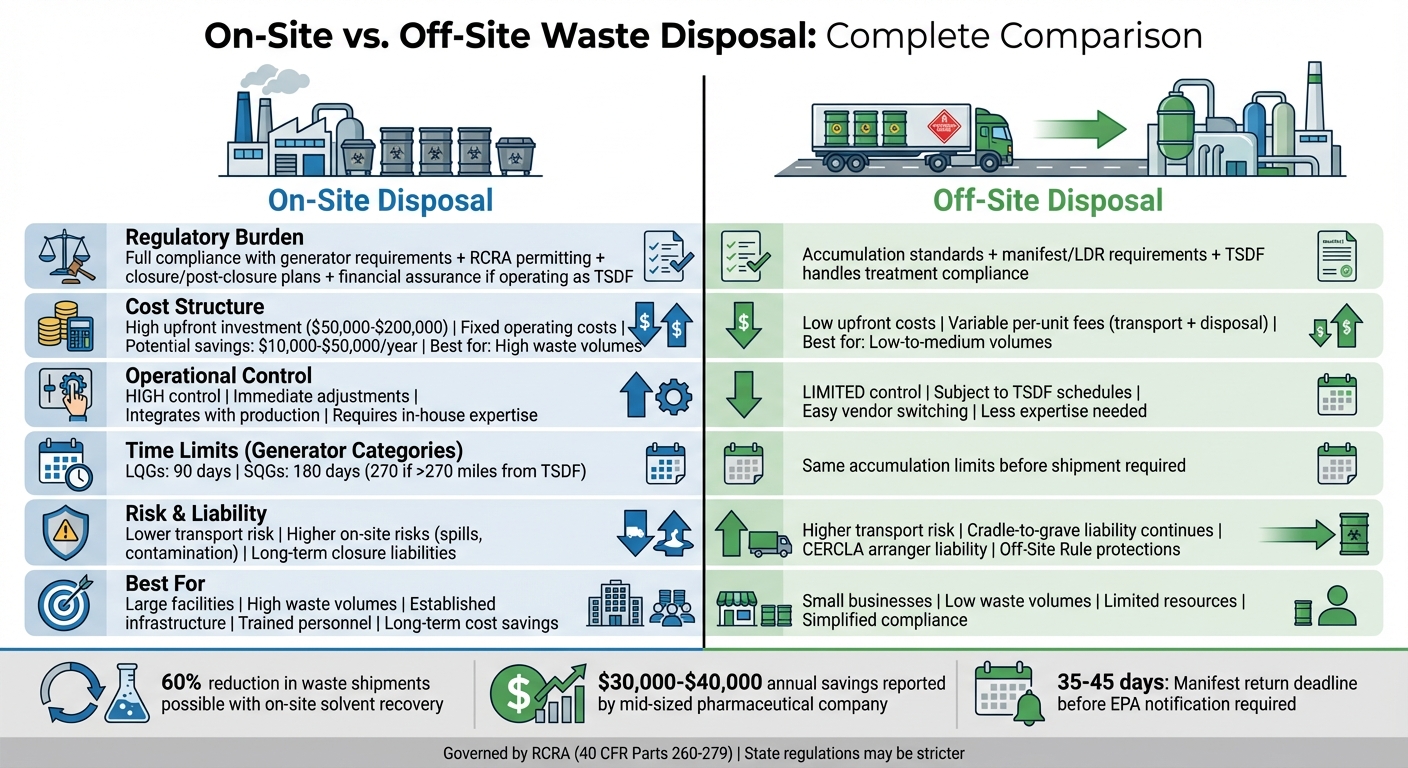
On-Site vs Off-Site Hazardous Waste Disposal: Regulatory Requirements and Cost Comparison
Choosing between on-site and off-site disposal involves weighing the benefits and challenges of each method, particularly in terms of compliance, costs, and the level of control over waste management. Each approach has its own operational advantages, but these must align with financial and regulatory demands.
On-site management provides a high degree of operational control. Facilities can coordinate waste collection, storage, and internal transfers to match production schedules without relying on external transport or facility availability. By setting up satellite accumulation areas near waste generation points, operations can be streamlined while staying within regulatory limits. The EPA also allows on-site recycling or treatment without a hazardous waste permit, as long as activities comply with accumulation standards under 40 CFR 262.15–17. This flexibility can help reduce both disposal volumes and associated costs.
However, managing waste on-site comes with significant costs. Facilities need to invest heavily in compliant storage areas, treatment systems, secondary containment, and safety infrastructure. Ongoing expenses include inspections, maintenance, staff training, and compliance monitoring. Strict accumulation time limits apply – 90 days for Large Quantity Generators (LQGs) and 180 days (or up to 270 days if the facility is over 270 miles away) for Small Quantity Generators (SQGs). Any lapses in container management, labeling, or inspections can lead to violations under the Resource Conservation and Recovery Act (RCRA) and hefty fines. Additionally, operating disposal units on-site increases responsibilities for safety, emergency preparedness, and potential long-term liabilities tied to closure or post-closure care.
Off-site disposal, on the other hand, shifts much of the treatment and disposal responsibility to permitted Treatment, Storage, and Disposal Facilities (TSDFs). This reduces the complexity and infrastructure requirements at the generator’s site, often requiring less upfront investment. Instead, costs are variable, based on transportation and disposal fees per unit of waste, making this approach more economical for facilities with lower or intermittent waste volumes. Off-site disposal also allows generators to leverage advanced treatment technologies at specialized facilities while avoiding long-term closure or post-closure care responsibilities. The Hazardous Waste Manifest System ensures cradle-to-grave tracking, providing clear documentation for compliance and legal purposes.
However, off-site disposal comes with its own challenges. Generators face additional manifesting and tracking requirements and must rely on the performance and availability of third-party facilities. Transportation risks also increase, and under the "cradle-to-grave" rule, generators remain liable for their waste even after it leaves their site. The EPA Off-Site Rule (40 CFR 300.440) requires generators to ensure that their waste is sent only to environmentally acceptable, compliant facilities, which reduces long-term liability but raises due diligence requirements. Delays in transportation or limited capacity at TSDFs may also necessitate contingency plans and additional on-site storage.
Here’s a summary of the key differences between these two options:
| Factor | On-Site Disposal | Off-Site Disposal |
|---|---|---|
| Regulatory Burden | Full compliance with generator requirements and additional standards for on-site units; RCRA permitting, closure/post-closure plans, and financial assurance if operating as a TSDF | Compliance with accumulation standards and manifest/LDR requirements; primary treatment/disposal compliance shifts to TSDF |
| Cost Structure | High upfront investment in infrastructure and fixed operating costs; cost-effective for higher waste volumes or on-site recycling | Lower upfront costs but variable per-unit expenses (transport + disposal fees); better for low-to-medium waste volumes |
| Operational Control | High control over processes, immediate adjustments possible, and integration with production cycles; requires in-house expertise and robust safety systems | Limited control, subject to TSDF schedules and acceptance criteria; easier to switch vendors or technologies |
| Risk & Liability | Lower transportation risk but higher on-site risks (spills, contamination); potential long-term liabilities for on-site disposal units | Increased transportation risks and potential CERCLA arranger liability; Off-Site Rule helps mitigate risks by requiring compliant facilities |
| State Variation Impact | States may impose stricter standards, affecting on-site accumulation and treatment (e.g., Virginia allows VSQGs to store up to 13,227 lb for 180–270 days) | State-specific rules may reduce storage times or require extra reporting, impacting the feasibility of off-site disposal |
Disclaimer: This content is for informational purposes only. Always consult official regulations and qualified professionals before making waste management decisions.
Conclusion
Deciding between on-site and off-site disposal depends on your generator category, risk tolerance, and the specific rules in your state. Under the Resource Conservation and Recovery Act (RCRA), generators are responsible for correctly identifying, storing, and disposing of hazardous waste – whether they manage it on-site or send it to a permitted Treatment, Storage, and Disposal Facility (TSDF) using the federal manifest system [1]. These decisions carry important regulatory and operational consequences.
Generator categories play a pivotal role in determining how much waste can be accumulated on-site and the timeframes for doing so. For smaller businesses with limited waste volumes or environmental resources, off-site disposal often proves to be a simpler and safer option. On the other hand, larger facilities with trained personnel and established systems may find on-site treatment or recycling under generator accumulation rules a cost-effective way to manage waste over the long term.
Industry-specific needs also shape disposal strategies. Highly regulated industries frequently choose off-site disposal to mitigate on-site risks. In such cases, working with suppliers that prioritize compliance and maintain thorough documentation can be advantageous. For instance, partnering with companies like Allan Chemical Corporation, which supports regulated industries with specialized chemicals and detailed documentation, helps streamline sourcing, waste classification, and compliance.
Before making a decision, it’s essential to confirm your generator category, understand the federal and state regulations that apply, assess your facility’s on-site capabilities, and evaluate the compliance and costs of off-site TSDF options. This approach aligns with earlier discussions on balancing regulatory requirements and operational needs.
Additionally, adopting waste minimization practices and selecting safer materials can lighten regulatory responsibilities and reduce long-term expenses. By aligning disposal practices with both legal obligations and operational strengths, businesses can enhance their overall compliance strategy.
Disclaimer: This content is for informational purposes only. Always consult official regulations and qualified professionals before making sourcing or waste management decisions.
FAQs
What are the main regulatory differences between on-site and off-site hazardous waste disposal?
The main regulatory differences between on-site and off-site hazardous waste disposal lie in how and where the waste is managed:
- On-site disposal means handling, storing, and treating hazardous waste directly at the facility’s location. This requires compliance with local, state, and federal regulations, including obtaining permits, undergoing regular inspections, and meeting strict operational requirements.
- Off-site disposal involves transporting hazardous waste to authorized treatment or disposal facilities. This process must follow transportation laws, include proper documentation like manifests, and meet safety standards to ensure the waste is handled responsibly.
Both approaches are tightly controlled to safeguard public health and the environment, making strict adherence to all regulations a must.
What does the ‘cradle-to-grave’ rule mean for hazardous waste generators?
The ‘cradle-to-grave’ rule places full responsibility on hazardous waste generators for their waste from the moment it is created until its final disposal. This means they are accountable for ensuring the waste is handled, transported, and disposed of properly to prevent harm to the environment and avoid legal repercussions.
Following this rule is crucial to comply with EPA regulations and safeguard public health. To meet these obligations, generators should partner with certified waste management companies and keep detailed records as proof of compliance.
What should businesses evaluate when choosing between on-site and off-site waste disposal?
When choosing between on-site and off-site waste disposal, businesses need to weigh several important factors to ensure they meet legal requirements and operate efficiently. Start by reviewing regulatory requirements – laws and guidelines often specify how hazardous waste must be managed, and non-compliance can lead to serious penalties. Alongside this, evaluate the safety protocols associated with each disposal method, as these can differ significantly.
Another critical aspect is the cost. On-site disposal may involve upfront expenses for facility setup, while off-site options include transportation and service fees. Logistics also play a role; the location of off-site facilities and ease of access can impact efficiency. For businesses generating large amounts of waste, the volume is a key consideration, as it may necessitate specialized handling or equipment. Finally, think about the environmental impact of each option, particularly if your company has goals tied to sustainability or industry benchmarks.



Comments are closed