
Top excipients for protein stabilization are essential that protect therapeutic proteins from degradation caused by environmental factors like temperature, light, and oxidation. These stabilizers, such as Polysorbates, Trehalose, and amino acids, play a critical role in maintaining the safety and effectiveness of protein-based drugs. However, manufacturers must navigate two key regulatory frameworks: USP (United States Pharmacopeia) and FDA (Food and Drug Administration).
Here’s the key difference:
- USP sets quality standards for stabilizers, focusing on chemical identity, purity, and impurity limits.
- FDA evaluates stabilizers in the context of specific drug formulations, emphasizing safety, stability, and degradation during storage.
Quick Overview of Key Points:
- USP Standards: Define excipient purity, fatty acid profiles, and impurity thresholds (e.g., ethylene oxide in Polysorbates).
- FDA Guidelines: Require stability testing under real-world conditions and assess degradation risks like free fatty acids or protein aggregation.
- Overlap: FDA often references USP standards, but manufacturers must meet both sets of requirements for approval.
Quick Comparison:
| Feature | USP Guidelines | FDA Guidelines |
|---|---|---|
| Primary Focus | Material purity and identity | Product safety and stability in use |
| Testing Emphasis | Impurities (e.g., ethylene oxide) | Degradation products (e.g., free fatty acids) |
| Application Scope | Universal excipient standards | Drug-specific formulation evaluation |
| Stability Conditions | Standardized lab testing | Real-time and stress testing |
Starting with compendial-grade stabilizers (USP/NF) simplifies compliance, but manufacturers must also conduct protein stabilizer testing and stability studies to ensure long-term safety. Both frameworks are essential to achieve regulatory approval for biopharmaceutical products.
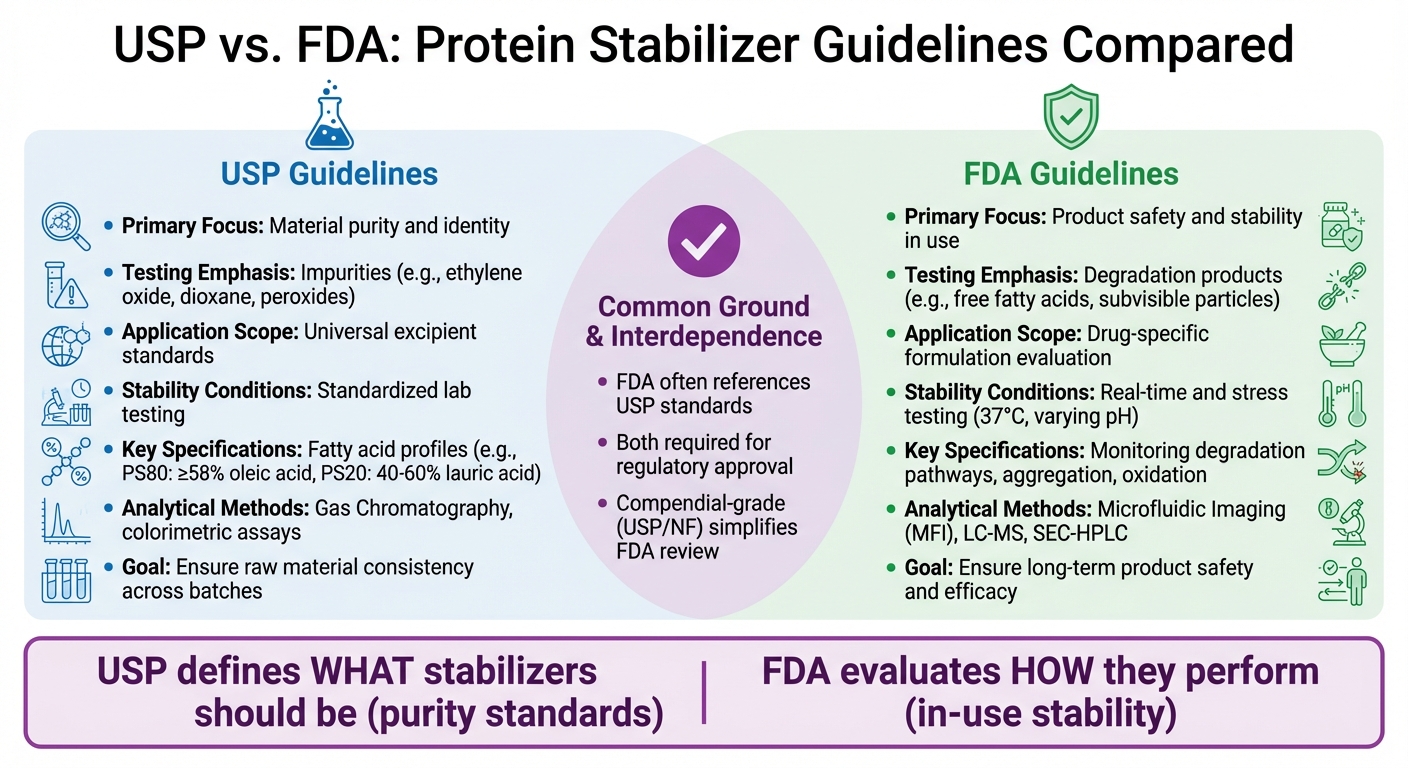
USP vs FDA Protein Stabilizer Guidelines Comparison Chart
USP Standards for Protein Stabilizers
The United States Pharmacopeia (USP) establishes quality benchmarks for compendial-grade protein stabilizers, detailing chemical identity, purity limits, and acceptable compositional ranges. These benchmarks are outlined in specific monographs, which ensure consistency and quality.
Key USP Monographs for Protein Stabilizers
USP monographs define the characteristics of Polysorbate 80 (PS80) and Polysorbate 20 (PS20). For PS80, the monograph specifies a minimum of 58% monounsaturated oleic acid, while PS20 must contain 40%–60% saturated lauric acid. These specifications account for natural variations in raw materials while maintaining reliable performance.
Impurity limits are strictly regulated. Both PS20 and PS80 must meet thresholds for ethylene oxide and dioxane, measured in parts per million (ppm) [5]. Additional parameters include limits on stearic acid, palmitic acid, and organic volatile impurities. A 2013 update increased the allowable stearic acid content in PS20 from <7.0% to <11.0%, reflecting advancements in data [6].
| Feature | Polysorbate 20 (USP-NF) | Polysorbate 80 (USP-NF) |
|---|---|---|
| Primary Fatty Acid | Lauric Acid (40%–60%) | Oleic Acid (≥58%) |
| Hydroxyl Value | 96–108 | 65–80 |
| Saponification Value | 40–50 | 45–55 |
| Stearic Acid Limit | <11.0% (Revised) | ≤6% |
| Palmitic Acid Limit | 7%–15% | ≤16% |
These specifications are verified through rigorous testing to ensure compliance with USP standards.
Testing and Certification Requirements
USP testing relies on HPLC vs. GC analysis to confirm fatty acid composition as per monograph guidelines. In September 2016, the USP Excipient Monographs 2 Expert Committee introduced a harmonized standard for Polysorbate 80, mandating a 50:1 split ratio for gas chromatography. This adjustment ensures proper resolution for system suitability and became official on August 1, 2017, in the First Supplement to USP 40–NF 35 [5].
Additional tests assess parameters such as hydroxyl value, saponification value, acid value, water content, and residue on ignition [7]. These tests confirm the purity and identity of each batch. For example, the bromine decolorization test distinguishes between stabilizers: PS20 decolorizes bromine dropwise, while PS80 does not [7].
Meeting these USP standards simplifies regulatory processes and ensures consistency across batches, reducing variability in protein formulations and easing FDA reviews [10]. This consistency is critical when selecting stabilizers for protein-based biopharmaceuticals to ensure long-term product efficacy.
This information is for guidance only. Always consult official regulations and qualified experts for sourcing and formulation decisions.
sbb-itb-aa4586a
FDA Requirements for Protein Stabilizers
The FDA evaluates protein stabilizers based on how they perform in specific drug formulations, differing from the USP’s approach of universal quality standards. While USP focuses on chemical identity and purity, the FDA tailors its requirements to the unique needs of each product.
FDA Inactive Ingredient Database (IID) and Concentration Limits
The Inactive Ingredient Database (IID) is the FDA’s go-to resource for assessing the safety of stabilizers in new drug applications. It lists excipients used in previously approved products, including their maximum potency for specific administration routes and dosage forms [11].
"If the IID includes a particular excipient at a specified potency for a certain route of administration, a sponsor could generally consider the excipient at that potency safe for use in a similar manner for a similar type of product." [11]
The IID provides two key metrics: the maximum excipient level per dosage unit and the Maximum Daily Exposure (MDE), which accounts for total daily dosing. For instance, if a formulation contains 0.5 mg of polysorbate 80 per injection and a patient receives three injections daily, the MDE would total 1.5 mg. As of October 1, 2020, the FDA has worked on improving the IID to allow electronic searches for MDI and MDE data [11].
If a manufacturer proposes stabilizer concentrations exceeding IID limits or intends to use a different administration route, they must supply independent safety data, often derived from nonclinical studies [11]. To address new excipients, the FDA’s Novel Excipient Review Pilot Program enables manufacturers to submit safety data for stabilizers before incorporating them into drug formulations [14]. After confirming potency, the FDA examines the stabilizer’s stability and safety within the specific drug.
Stability and Safety Considerations
The FDA mandates stability testing under actual storage conditions to support claims for shelf life and expiration dates. These tests monitor degradation processes such as deamidation, oxidation, aggregation, or fragmentation [2]. Unlike USP protocols, the FDA requires real-time stability testing to ensure that degradation does not compromise the therapeutic protein’s effectiveness or safety [2].
For biosimilars, the FDA insists on analytical comparisons to prove that they are "highly similar" to reference products, even if stabilizers differ slightly [12][13]. The evaluation process considers the totality of analytical data rather than just matching reference product attributes [12]. Any differences in stabilizer composition require risk assessments to determine potential effects on clinical performance, safety, and purity [12].
Stability studies must also consider how the container system interacts with the formulation under various storage orientations [2]. Using compendial-grade excipients (USP/NF) from early development through to manufacturing simplifies the FDA review process by ensuring consistent quality [3]. The FDA defines proteins as alpha amino acid polymers with sequences longer than 40 amino acids, while peptides have 40 or fewer monomers [13][15]. These guidelines illustrate the FDA’s commitment to ensuring that stabilizers meet the specific safety and efficacy needs of each formulation.
This content is for informational purposes only. Consult official regulations and qualified professionals before making sourcing or formulation decisions.
Comparing USP and FDA Guidelines for Protein Stabilizers
Comparison of Key Specifications
When it comes to protein stabilizers, USP and FDA guidelines serve different purposes. USP emphasizes the purity of raw materials, while the FDA focuses on how these materials perform during use. Understanding these distinctions is crucial for manufacturers aiming to meet both standards.
| Feature | USP Approach (Compendial) | FDA Approach (Regulatory/Safety) |
|---|---|---|
| Primary Goal | Material identification and purity | Product safety and in-use stability |
| Key Specifications | Fatty acid profiles (e.g., minimum 58% oleic acid for PS80) and impurity limits like ethylene oxide and dioxane | Monitoring degradation products such as free fatty acids and subvisible particles |
| Testing Focus | Impurity assessment in raw excipients (e.g., stearic acid limits) | Stability evaluation during storage (e.g., aldehyde and ketone formation) |
| Stability Conditions | Standardized shelf-life testing (e.g., USP <1049>) | Stress testing under conditions like 37°C and varying pH levels |
| Analytical Methods | Techniques like Gas Chromatography and colorimetric assays | Advanced methods such as Microfluidic Imaging (MFI) and LC-MS |
USP-NF standards focus on defined fatty acid profiles and impurity limits, while FDA guidelines prioritize monitoring how stabilizers degrade over time. These contrasting approaches guide manufacturers in choosing stabilizers and designing compliance strategies.
Focus Areas: Impurities vs. Degradation Products
The main difference between USP and FDA lies in their focus: USP examines impurities present during material sourcing, while FDA evaluates degradation products that form during storage and use. For example, USP tests for residual manufacturing impurities like ethylene oxide, dioxane, and peroxides [9]. Meanwhile, FDA studies focus on byproducts such as free fatty acids and subvisible particles, which can compromise protein stability and patient safety [8].
"Hydrolysis of polysorbate is one of the sources for the formation of subvisible particles in therapeutic protein formulation, but additional studies are needed to better understand the safety and quality impact."
- Baikuntha Aryal, Researcher, FDA/CDER/OPQ [8]
This distinction is especially relevant when residual host cell proteins (HCPs), such as lipases, accelerate stabilizer degradation. Research shows that even trace amounts of these enzymes – concentrations as low as 1 ppm – can degrade polysorbates [10]. While USP methods may not detect these risks, FDA stability studies track their impact on protein aggregation and potential immunogenicity. To meet FDA requirements, manufacturers often need advanced analytical tools beyond those specified by USP, ensuring long-term product safety [9].
This content is for informational purposes only. Consult official regulations and qualified professionals before making sourcing or formulation decisions.
What This Means for Biopharmaceutical Manufacturers
Sourcing Compendial-Grade Stabilizers
The differences between USP and FDA guidelines make it essential to start with compendial-grade materials. Using USP/NF-grade stabilizers during early development and preformulation can help avoid regulatory challenges later, especially when transitioning to GMP manufacturing.
Compendial-grade stabilizers are designed to control impurities, such as trace peroxides, which can lead to protein oxidation and trigger immunogenic responses. Since protein stabilization energy typically falls between 5 and 20 kcal/mol – comparable to just a few hydrogen bonds – small variations in excipients can lead to protein degradation or aggregation [3]. To prevent this, manufacturers must carefully manage storage conditions to avoid the formation of reactive species over time.
Reliable sourcing partners play a critical role here. For example, Allan Chemical Corporation, with over 40 years of experience, provides USP and NF-grade stabilizers, offering just-in-time delivery and thorough documentation, including Certificates of Analysis and Safety Data Sheets. Their direct relationships with vetted manufacturers ensure consistent quality across batches, meeting the stringent purity standards set by USP and the stability guidelines outlined by the FDA.
By prioritizing high-quality sourcing, manufacturers can establish a strong foundation for meeting regulatory requirements.
Strategies for Regulatory Compliance
Once sourcing is secured, manufacturers need to adopt specific strategies to meet both USP and FDA standards. A key step is selecting excipients already listed in the FDA Inactive Ingredient Database (IID). This can simplify approval processes and reduce regulatory hurdles. As Jens T. Bukrinski, a Formulation Scientist at Novozymes, explains:
"New excipients – whether just new to the company or compounds that have not been used as excipients before – will only be used if they have significantly high value and can compensate for the extended approval process." [3]
Analytical testing must cover both USP’s emphasis on raw material purity and FDA’s focus on product stability in use. This often involves employing advanced methods like SEC-HPLC and IEX, along with stress testing under conditions such as 37°C and varying pH levels. A Design of Experiment (DoE) approach can help determine the ideal stabilizer levels and reveal any interactions between multiple excipients [3]. For liquid formulations in vials, stability studies should also include inverted or horizontal storage to uncover potential interactions with the container-closure system.
Comprehensive documentation is equally important. USP General Chapter <1049> requires stability-indicating profiles that validate identity, purity, and potency. On the other hand, FDA submissions must include detailed degradation pathway data, with a focus on subvisible particles and residual host cell proteins that could accelerate stabilizer breakdown. Balancing these requirements ensures products meet compendial standards at release and remain safe and effective throughout their shelf life.
This content is for informational purposes only. Always consult official regulations and qualified professionals for sourcing or formulation decisions.
Conclusion
Biopharmaceutical manufacturers are tasked with meeting both USP and FDA requirements when using protein stabilizers. USP sets compendial standards through specific monographs and validated methods for stabilizers like Trehalose and Polysorbate 80 grade selection. On the other hand, the FDA focuses on ensuring the finished drug product maintains safety, purity, and potency throughout its shelf life.
USP emphasizes compendial vs. non-compendial testing using physical Reference Standards, while the FDA requires comparative assessments to confirm stabilizer variations do not compromise protein integrity. For marketing applications, the FDA typically mandates at least 6 months of stability data at submission for products with storage periods longer than that timeframe [2]. These differences highlight the regulatory complexities manufacturers must navigate.
Manufacturers are expected to align USP-NF specifications with detailed CMC data that includes stabilizer concentration and protein degradation profiles [4][2]. USP experts note that associated Reference Standards are often available to support method development, validation, and testing [1].
Polysorbates, commonly used at concentrations of 0.003–3 mg/mL, can degrade into free fatty acids, leading to visible or subvisible particles [16]. Proteins are especially sensitive to environmental factors like temperature fluctuations, oxidation, and ionic content. Maintaining their molecular structure requires adherence to USP’s purity standards and the FDA’s stability requirements [2]. Allan Chemical Corporation aids in achieving this dual compliance by providing USP- and NF-grade stabilizers with detailed documentation, ensuring manufacturers can establish quality from the outset. Combining analytical precision with reliable sourcing is essential for regulatory success.
This comparison highlights the need for unified standards and proactive quality management in biopharmaceutical manufacturing.
This content is for informational purposes only. Consult official regulations and qualified professionals before making sourcing or formulation decisions.
FAQs
Do I still need FDA stability studies if my excipient is USP/NF grade?
USP/NF grade excipients adhere to pharmacopeial standards, but they are still subject to FDA stability testing requirements. These tests play a critical role in verifying shelf life and maintaining product quality, particularly for regulatory submissions or commercial applications. Both USP and FDA stress that stability data is essential to guarantee the safety and effectiveness of a product, regardless of the excipient’s grade.
What polysorbate degradation risks should I monitor beyond USP impurity limits?
Monitoring polysorbate degradation is crucial for maintaining protein stability in biopharmaceutical formulations. Degradation can occur through two main pathways: enzyme-mediated hydrolysis and oxidative degradation. These processes lead to the formation of free fatty acids (FFA) and subvisible particles, both of which can compromise protein stability.
Residual host cell proteins, such as lipases and esterases, often accelerate hydrolysis. On the other hand, oxidative degradation can be triggered by factors like light exposure, metal ions, or the presence of peroxides. Keeping a close eye on these pathways is essential to ensure the stability and efficacy of biopharmaceutical formulations.
When do I need safety data if my stabilizer level exceeds the FDA IID limits?
If the stabilizer level in your product surpasses the FDA IID (Inactive Ingredient Database) limits, safety data becomes necessary. As outlined in 21 CFR §640.84, specific stabilizers are required to stay within defined concentrations. Going beyond these thresholds may prompt a safety evaluation to ensure both compliance with regulations and the safety of the product.




Comments are closed